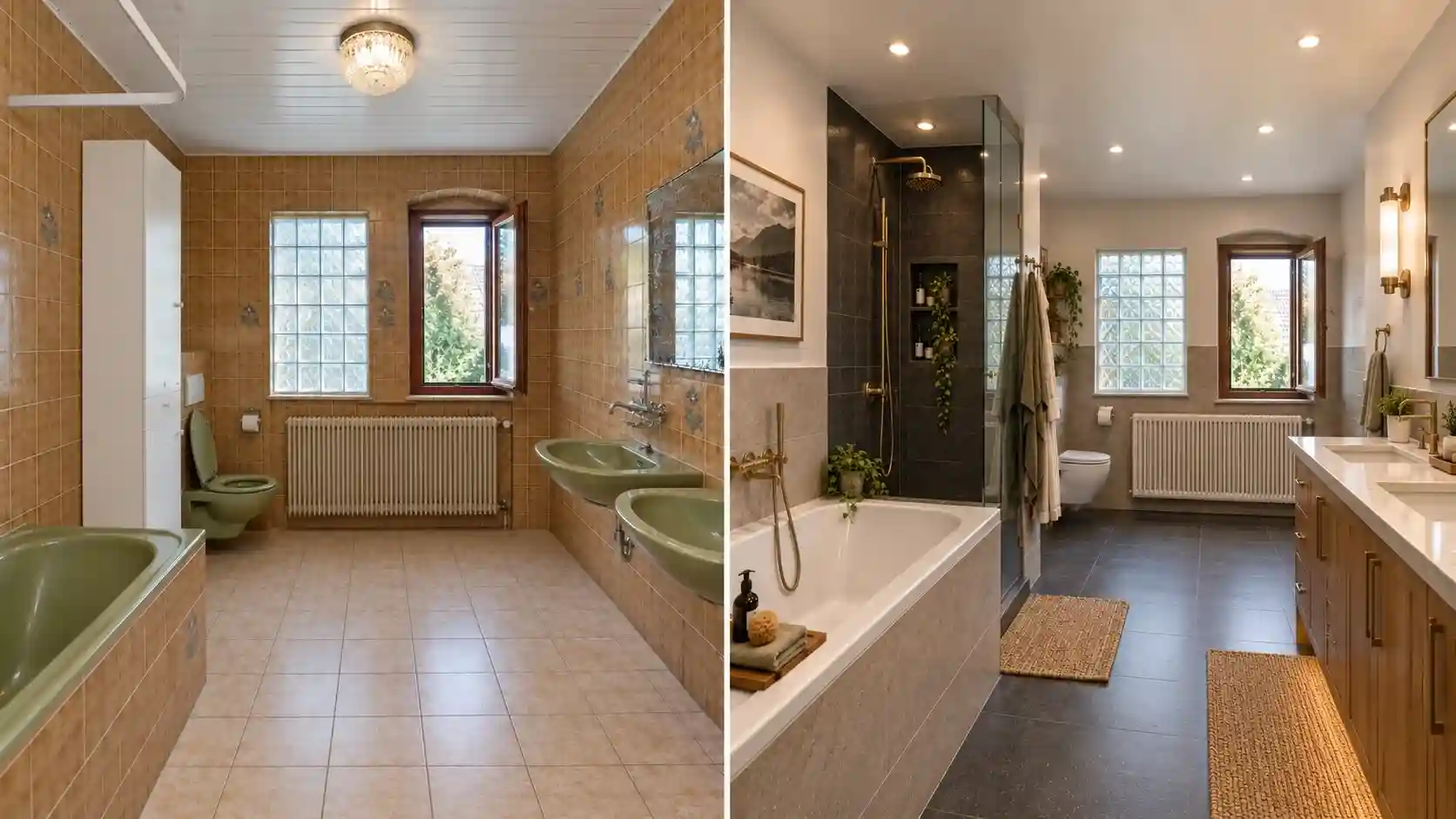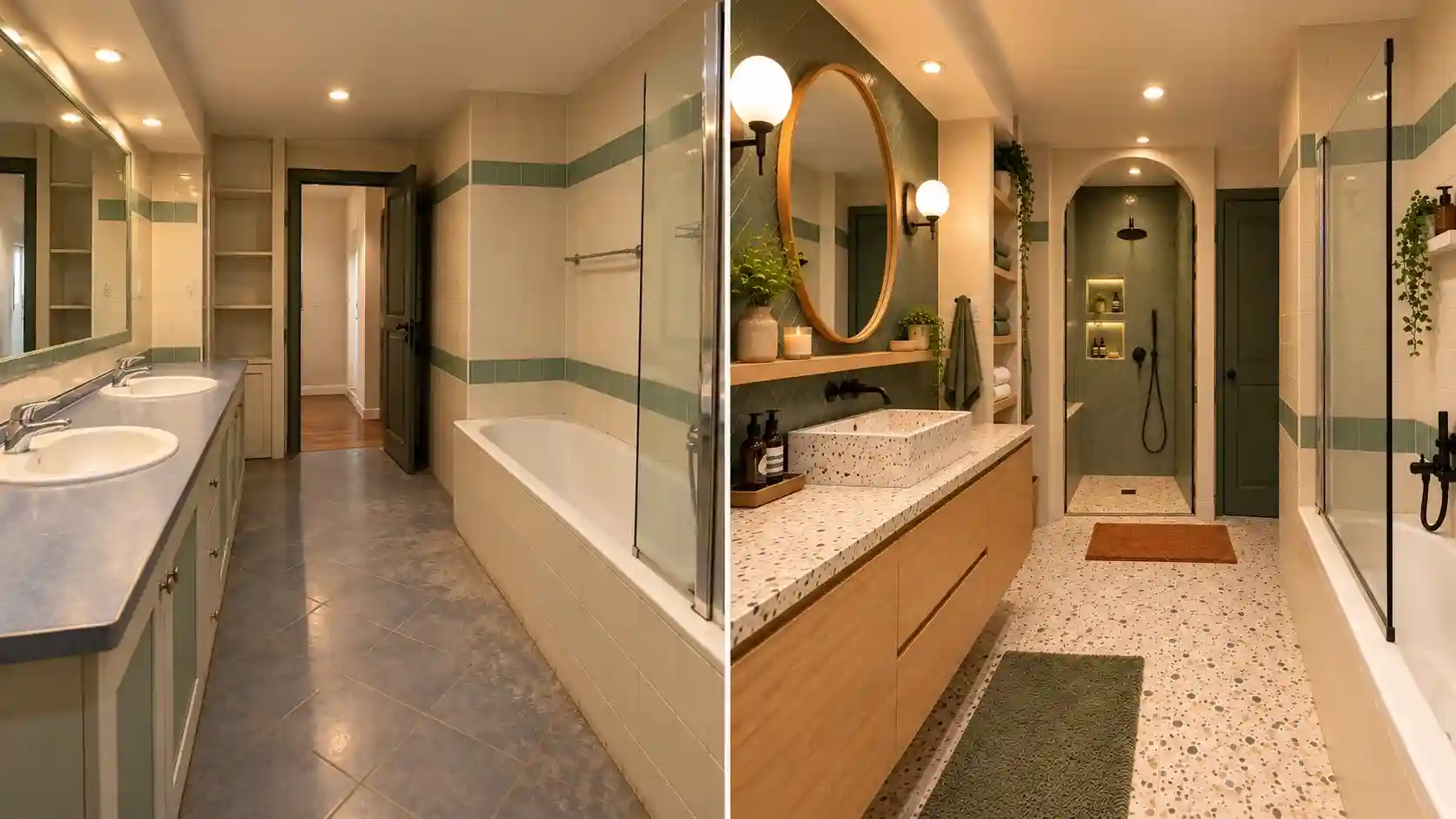
Most countertop advice is written for kitchens. Bathrooms are a different job: small tops, constant steam, hair tools, and a sink cutout that can make or break the whole thing.
Quick answer: For most bathrooms, quartz is usually best: non-porous, low maintenance, consistent look. Granite handles heat and offers natural variation but needs sealing. Solid surface wins for seamless integrated sinks and repairability. Australia has banned engineered stone, so check availability first.
Quick takeaways
- Quartz is the lowest-upkeep option. Granite may need sealing. Solid surface gives you seamless sinks and sand-out repairs.
- Hair tools and harsh cleaners are the real hazards, not hot pans.
- On a small top, fabrication minimums and plumber time can outweigh the material price.
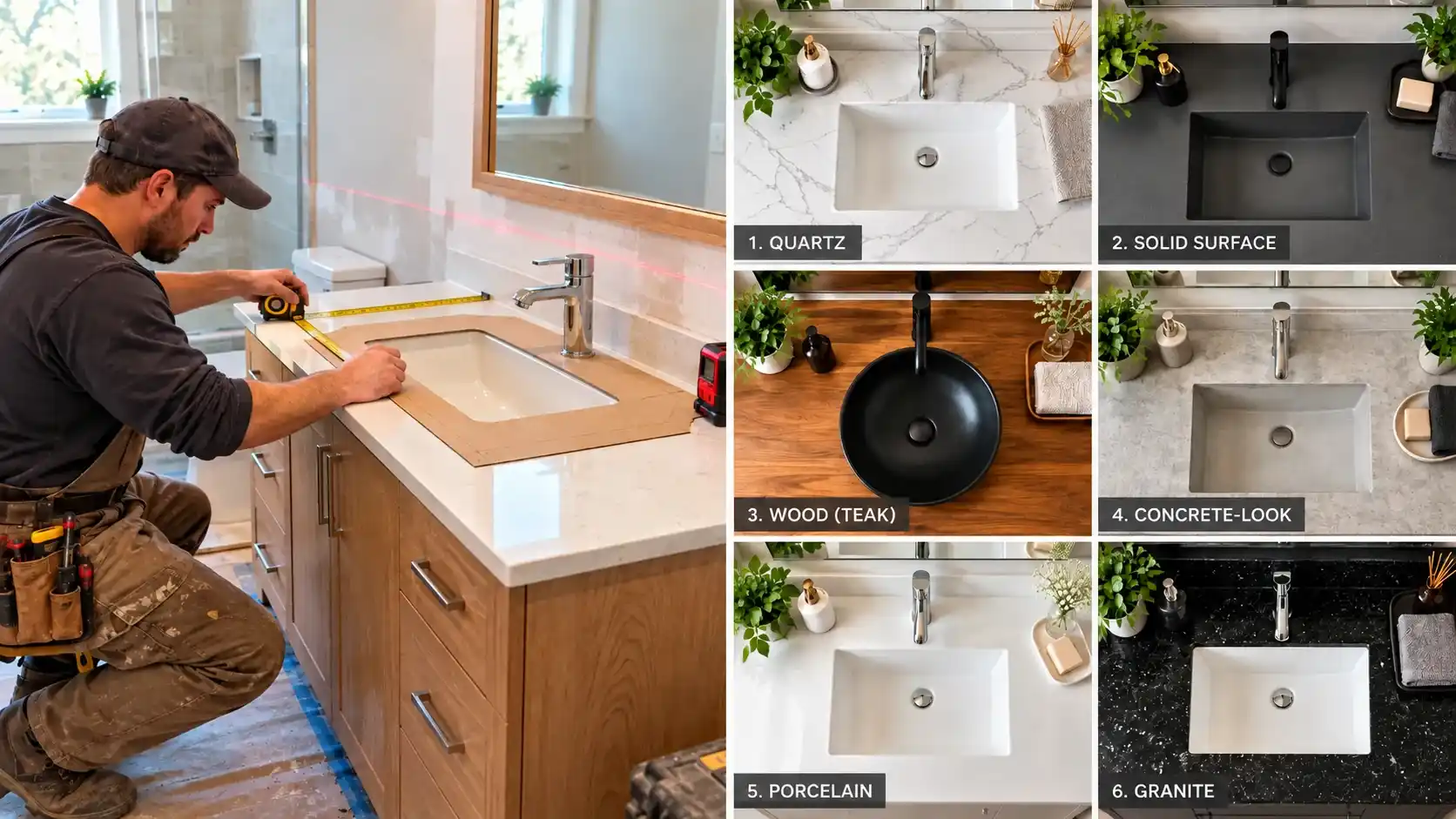
- Template only after the vanity is level and the sink and faucet are on site.
- Stone is heavy, so floating vanities need confirmed wall backing.
Quartz, granite and solid surface: what you’re actually buying
Three materials do most of the work in bathrooms, and they’re more different than the showroom samples suggest.
- Quartz is engineered stone: crushed quartz bound with polymer resin and pressed into slabs. Consistent patterns, no sealing.
- Granite is quarried natural stone, cut and polished. No two slabs match, and porosity varies from one stone to the next.
- Solid surface is acrylic or polyester resin with mineral fillers. It can be joined and shaped, which is how a sink ends up molded right into the top.
You’ll also see cultured marble (inexpensive, usually sold as a one-piece top with the basin), laminate, and porcelain slab. They’re worth knowing about, but quartz, granite and solid surface are where most real decisions land.
One naming trap: in Australia, most “quartz” is sold and regulated as engineered stone. More on that below.
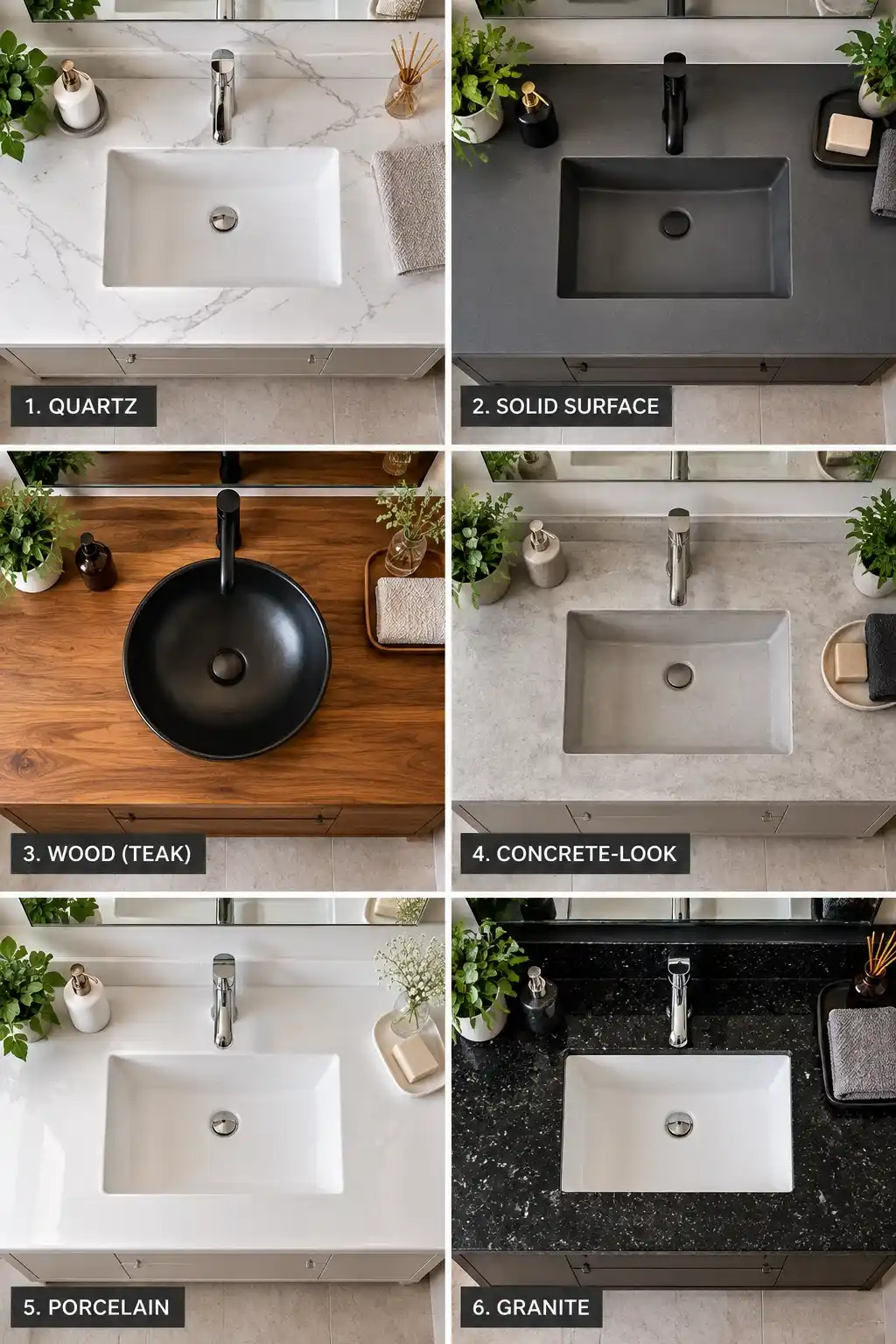
How the three compare in a steamy, splash-heavy bathroom
Here’s the comparison with real bathroom conditions in mind.
| Factor | Quartz | Granite | Solid surface |
|---|---|---|---|
| Water and stains | Non-porous, resists most stains | Porosity varies by stone; seal as needed | Non-porous, resists most stains |
| Heat (hair tools) | Resin can mark under direct heat | Most heat-tolerant of the three | Can scorch or mark |
| Scratches and chips | Hard; edges can chip | Hard; edges can chip | Scratches more easily, but often sanded out |
| Upkeep | Wipe clean | Occasional sealing, depending on stone | Wipe clean; repair by sanding |
| Sinks and seams | Undermount or drop-in | Undermount or drop-in | Integral sink and coved backsplash possible |
| Weight | Heavy | Heavy | Lighter |
| Look | Consistent patterns | Natural variation | Uniform, fewer premium patterns |
| Best for | Low-upkeep family bathrooms | Heat tolerance, natural-stone look | Rentals, accessible homes, integrated sinks |
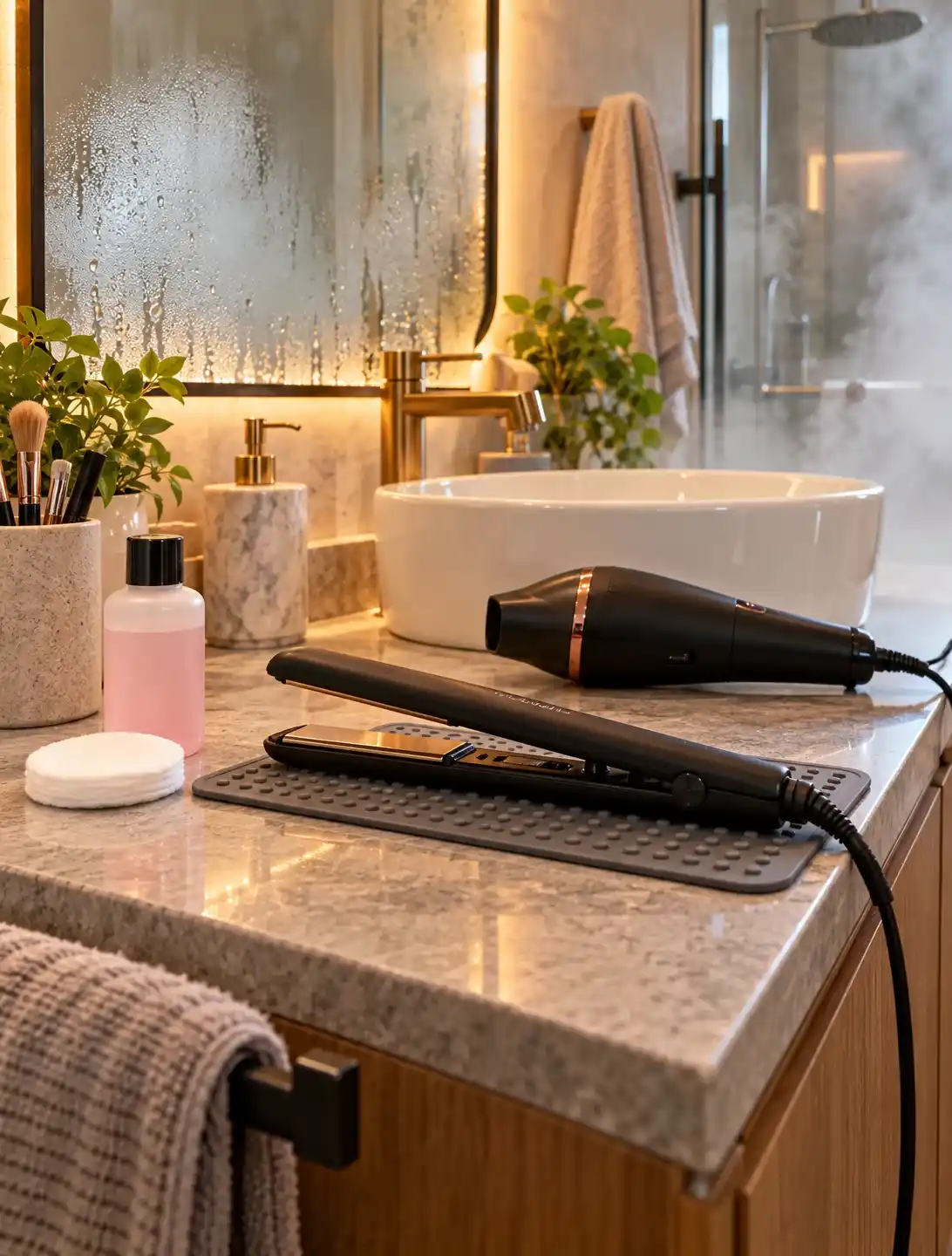
Notice what barely matters here: hot-pan tolerance. A flat iron balanced on the edge of the basin is a far likelier accident than a skillet.
Regional note (US/UK/CA/AU): Where engineered stone is restricted (more below), the practical shortlist becomes granite, solid surface or porcelain slab.
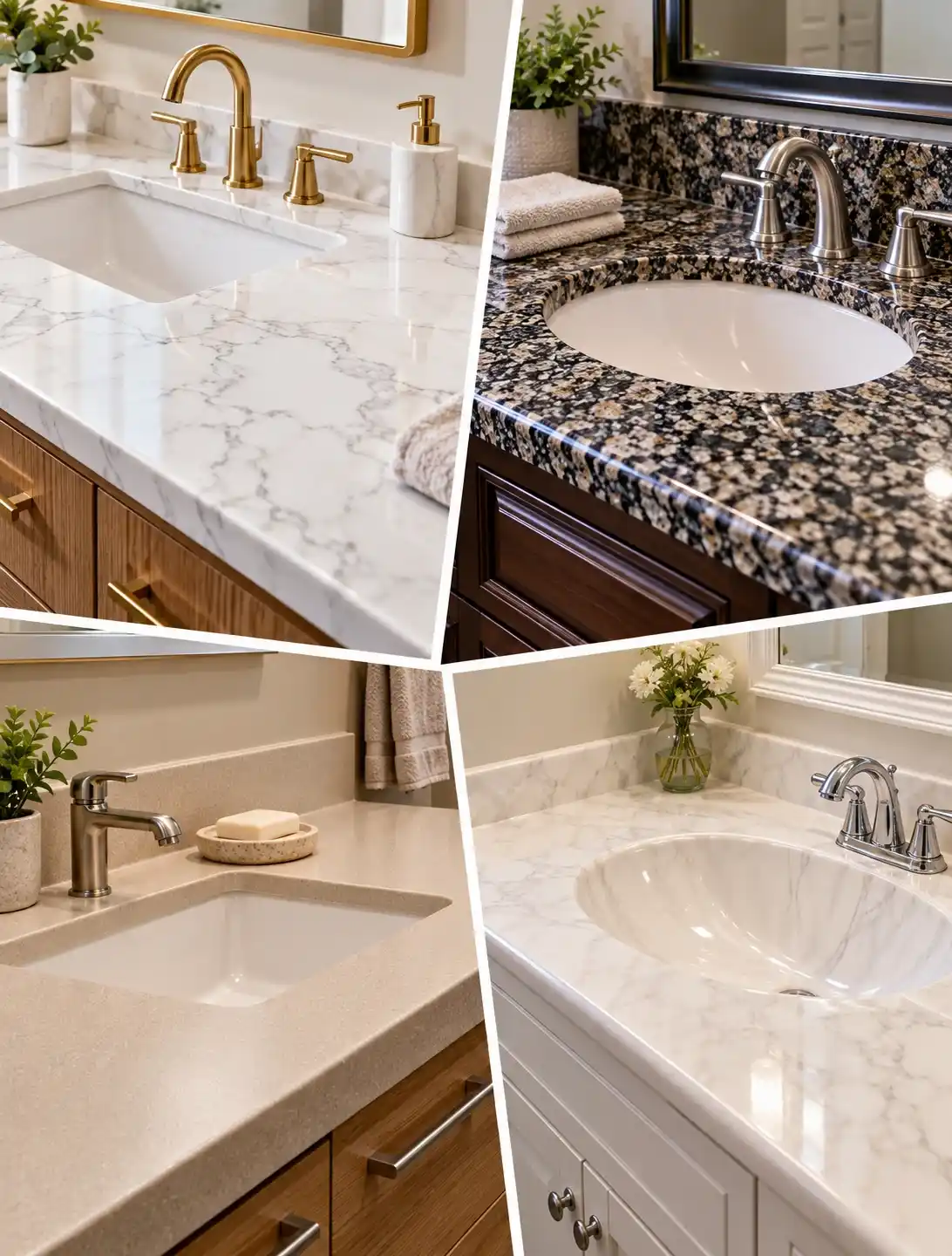
What happens when a hair tool, nail polish remover or hard water meets the top?
Most homeowners don’t realize how little kitchen testing says about a bathroom top. The damage here is quieter: a dull patch where acetone sat, a scorch mark at the back edge, a dark line where water crept under tired sealant.
| Everyday moment | Quartz | Granite | Solid surface |
|---|---|---|---|
| Hot flat iron set down | Can mark or scorch; use a heat mat | Most forgiving | Can mark; use a heat mat |
| Nail polish remover or hair dye | Resists staining, but harsh solvents can dull the finish | Usually fine if sealed; wipe promptly | Solvents can mar the surface |
| Toothpaste, soap, hard-water splashes | Wipe clean | Wipe clean if sealed | Wipe clean |
| Standing water at the sink edge | Fine, if the sealant joint stays intact | Fine if sealed | Fine with an integral sink |
| A scratch from something hard | Rarely shows | Rarely shows | May show, but often sanded out |
A silicone heat mat and a pH-neutral cleaner are cheap insurance. The bigger lever is the sealant joint at the splash and around the sink rim. That joint, not the stone, is where water actually gets in, so recaulk it when it cracks. And if steam hangs around after every shower, look at the fan first. An undersized exhaust fan keeps the room damp, and lingering moisture is hard on sealant joints and invites mold.
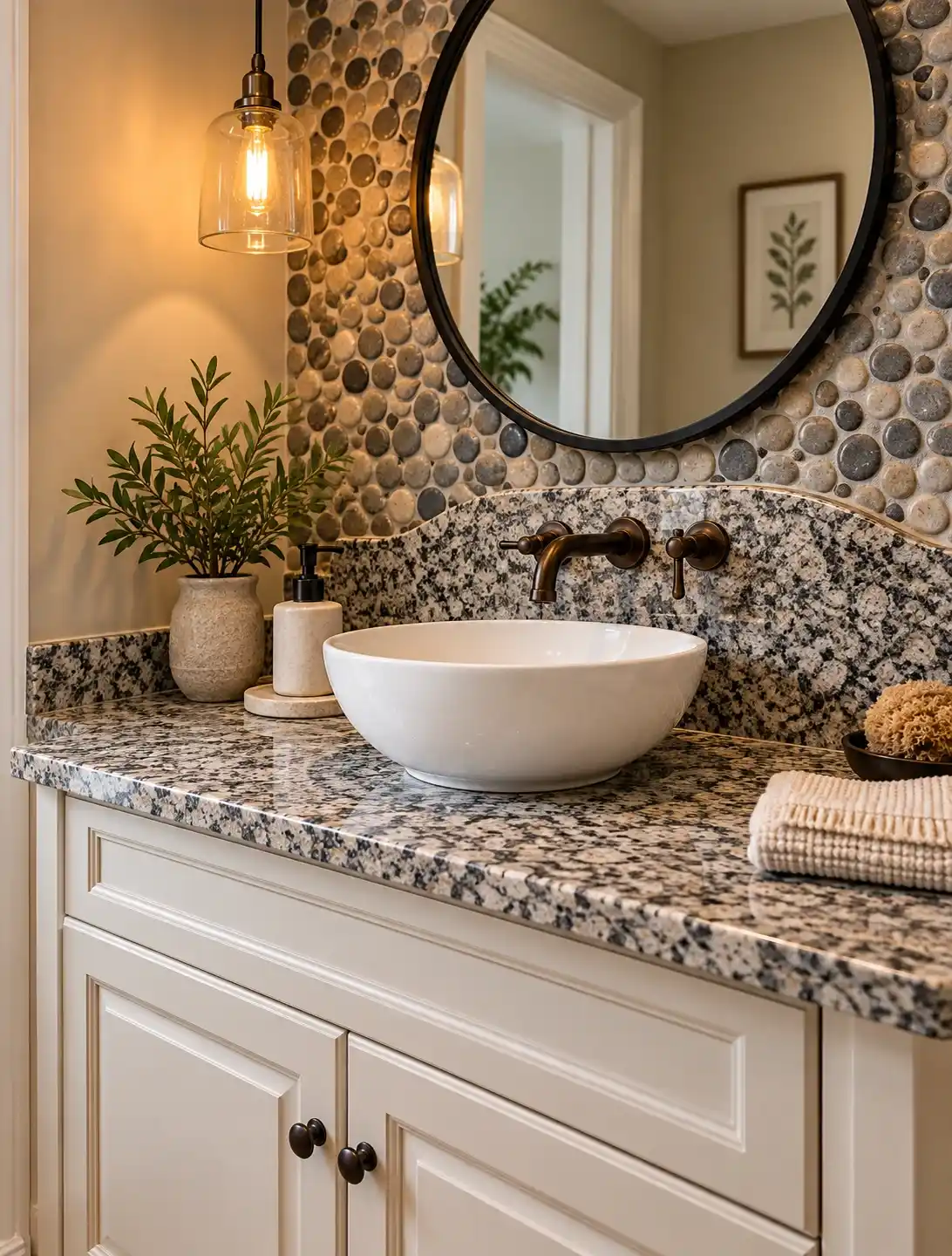
Can you even buy quartz where you live?
If you’re in Australia, the quartz vs granite question may already be answered for you. Elsewhere, the differences come down to who fabricates it and what sits near the basin.
| US | UK | Canada | Australia | |
|---|---|---|---|---|
| Quartz / engineered stone | Available | Available | Available | Banned for manufacture, supply and installation since 1 July 2024, with limited exceptions. Verify current rules |
| Silica dust in fabrication | Workplace rules (OSHA) | Workplace rules (HSE) | Provincial workplace rules | Strictly regulated |
| Electrical near the basin | NEC (NFPA 70): GFCI protection | BS 7671: zones restrict sockets | CEC (CSA C22.1): GFCI near sinks | AS/NZS 3000: RCD protection, zones |
| Replacing just the top | Usually no permit | Usually no permit | Usually no permit | Usually no permit |
These are principles, not guarantees. Verify with your local building authority, especially if you’re moving outlets or plumbing. Terms differ too: what Americans call a countertop is a worktop in the UK and a benchtop in Australia, and the lip behind it is a backsplash, upstand or splashback depending on where you live.
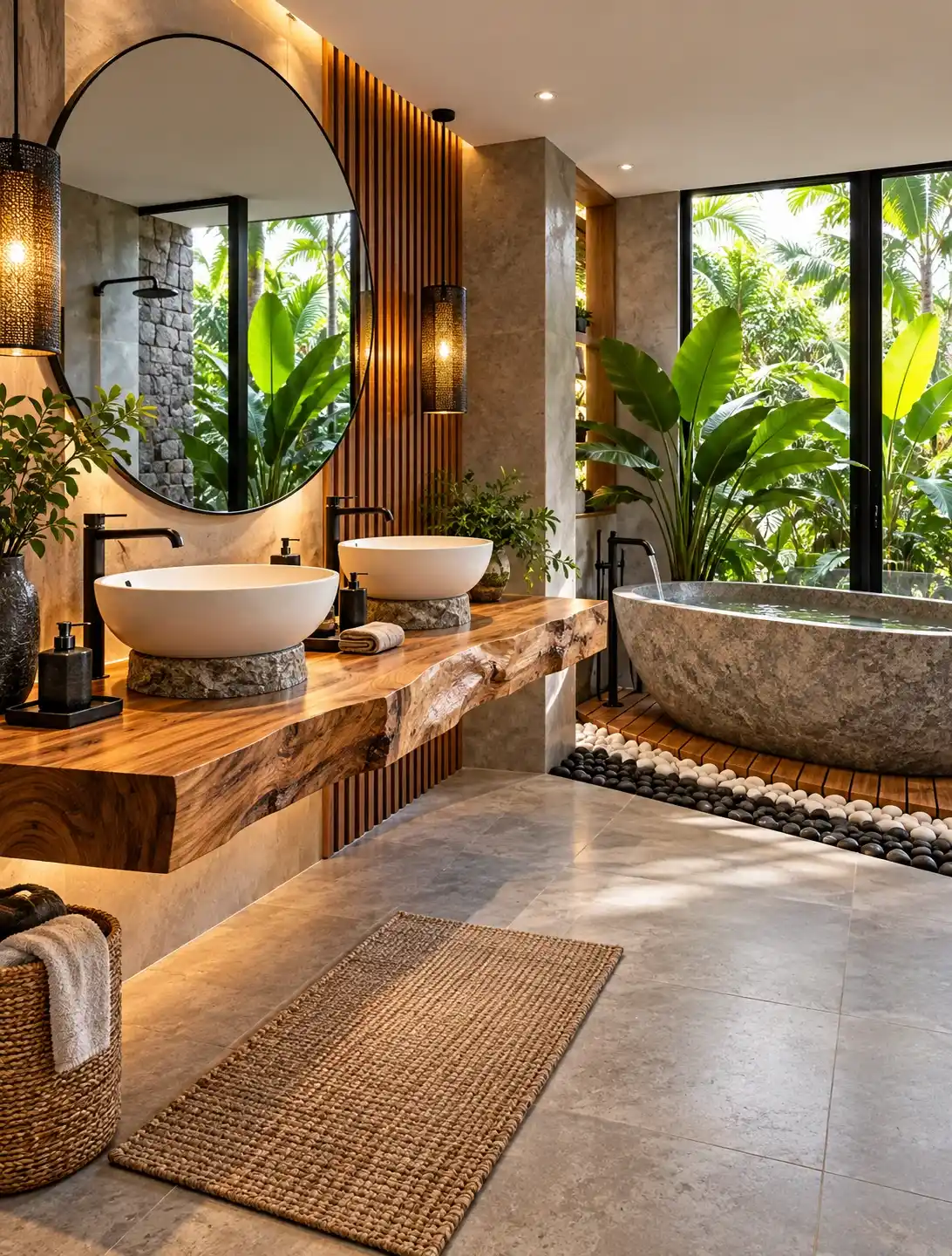
The fit-and-support checks that decide whether your top survives
The slab is the easy part. What cracks, leaks or pulls off the wall is usually the stuff under and around it. If you’re still picking the cabinet, settle that first. Then, before anyone templates your top, run this list:
- Vanity cabinet is installed, level and fixed to the wall
- Sink is physically on site, with its cutout template
- Faucet is chosen and hole spacing confirmed with the fabricator
- Shut-off valves and supply positions are noted
- Outlet and switch positions at splash height are confirmed with an electrician
- Wall is checked for out-of-square so the fabricator can scribe
- Overhang and edge details are agreed
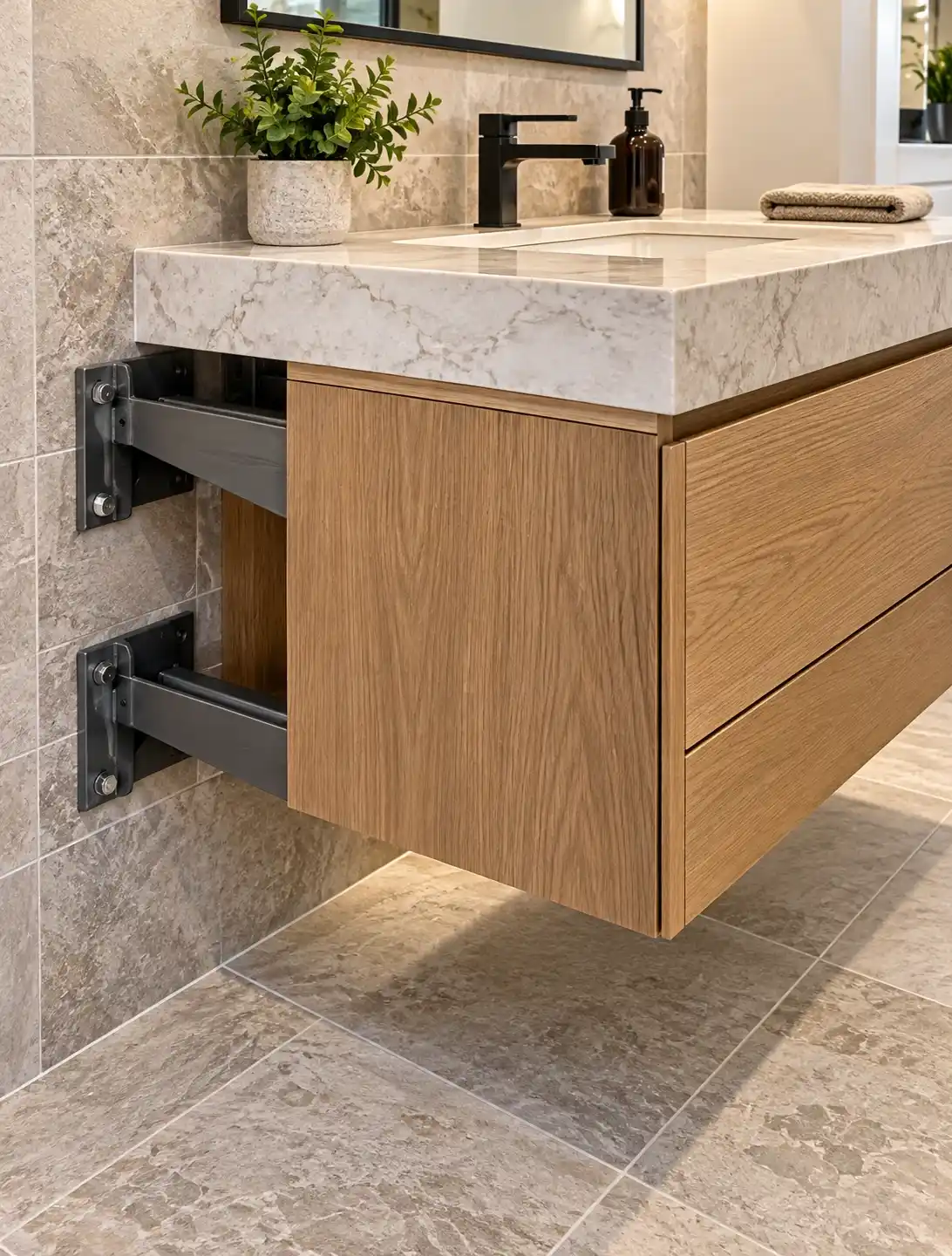
- Floating vanity: backing and rated brackets confirmed
- Access path (stairs, tight corners) checked for slab pieces
- Cabinet and subfloor checked for old moisture damage
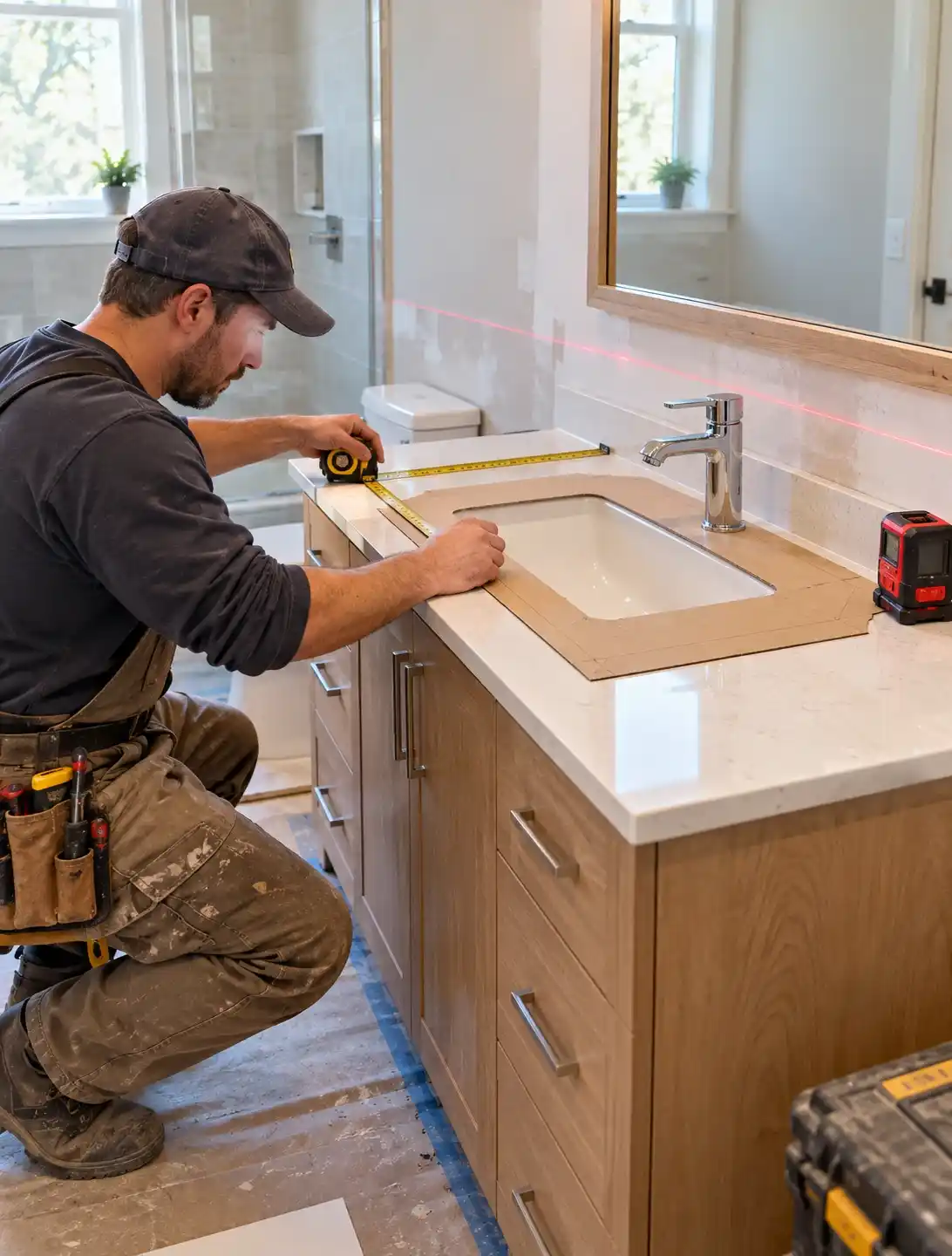
Vanity depth matters too. It eats into walkway clearance, so check it against your door swing and the space left in front of the toilet and shower before you order.
⚠️ Warning: Never dry-cut engineered stone or granite at home. The dust contains respirable crystalline silica, a hazard even on short jobs.⚠️ Warning: Don’t template until the sink and faucet are physically on site. Cutouts and drilled holes can’t be changed afterward.⚠️ Warning: Don’t put a stone top on a floating vanity without confirmed backing and rated brackets. Failure usually shows up as a cracked top or a pulled bracket.
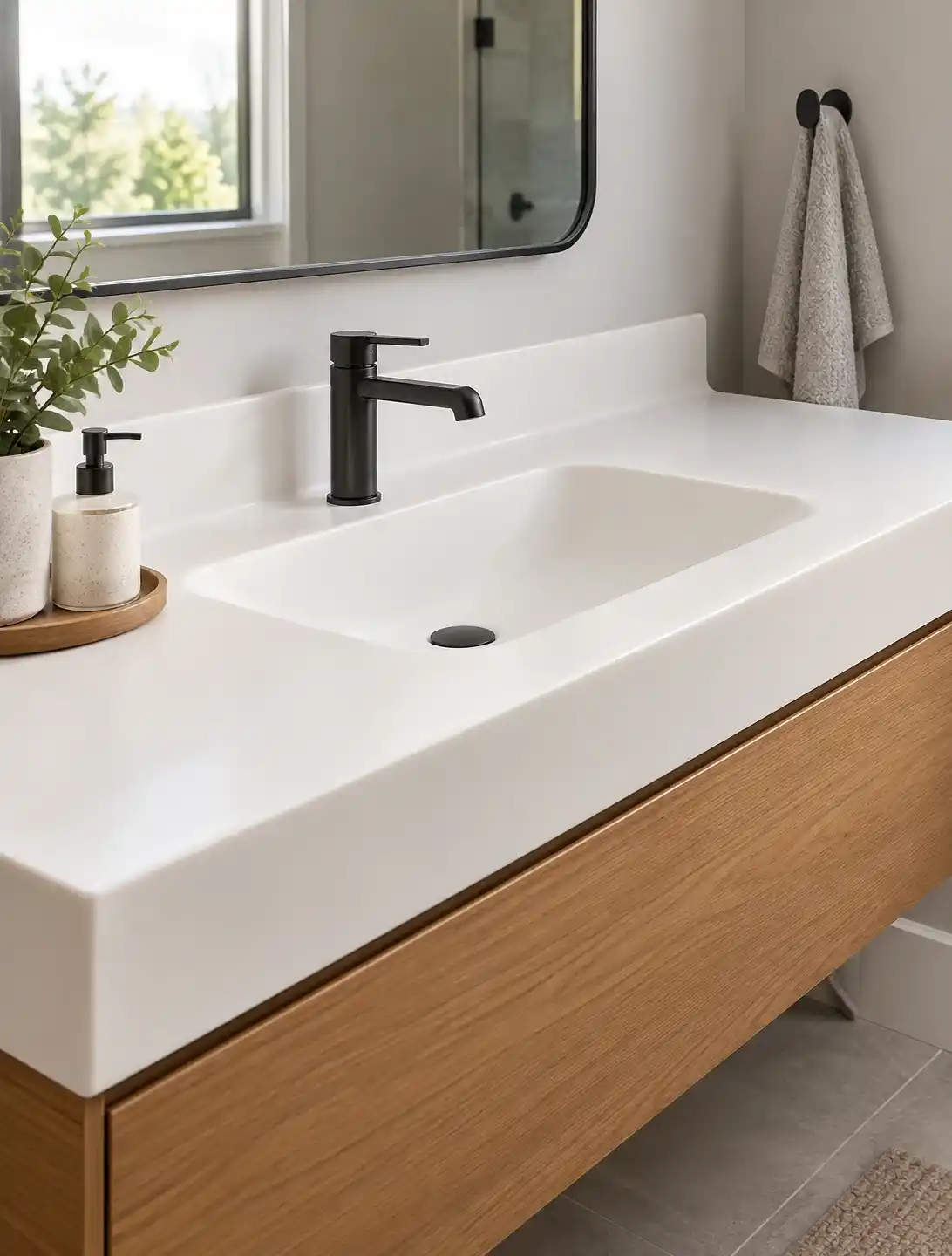
What a bathroom countertop really costs (and why small tops aren’t cheap per square foot)
A vanity top is only a few square feet, so you’re paying for a fabricator’s visit as much as for stone. Minimum charges and cutouts flatten the price gap between quartz and granite.
Estimated planning ranges in USD, installed. Get local quotes.
| Item | Low | Typical | High | What moves the price |
|---|---|---|---|---|
| Prefab top with integrated sink (cultured marble or solid surface) | $150 | $300 | $700 | Brand, size, faucet drilling |
| Fabricated solid surface, single vanity | $350 | $650 | $1,100 | Integral sink, coved backsplash |
| Fabricated quartz, single vanity | $450 | $800 | $1,400 | Slab, edge, minimum charge |
| Fabricated granite, single vanity | $400 | $750 | $1,300 | Stone grade, remnants, sealing |
| Double-vanity stone top | $800 | $1,600 | $2,800 | Length, seam, cutouts |
| Removal, plumber reconnect, cutout extras | $225 | $500 | $1,100 | Access, valve condition, undermount |
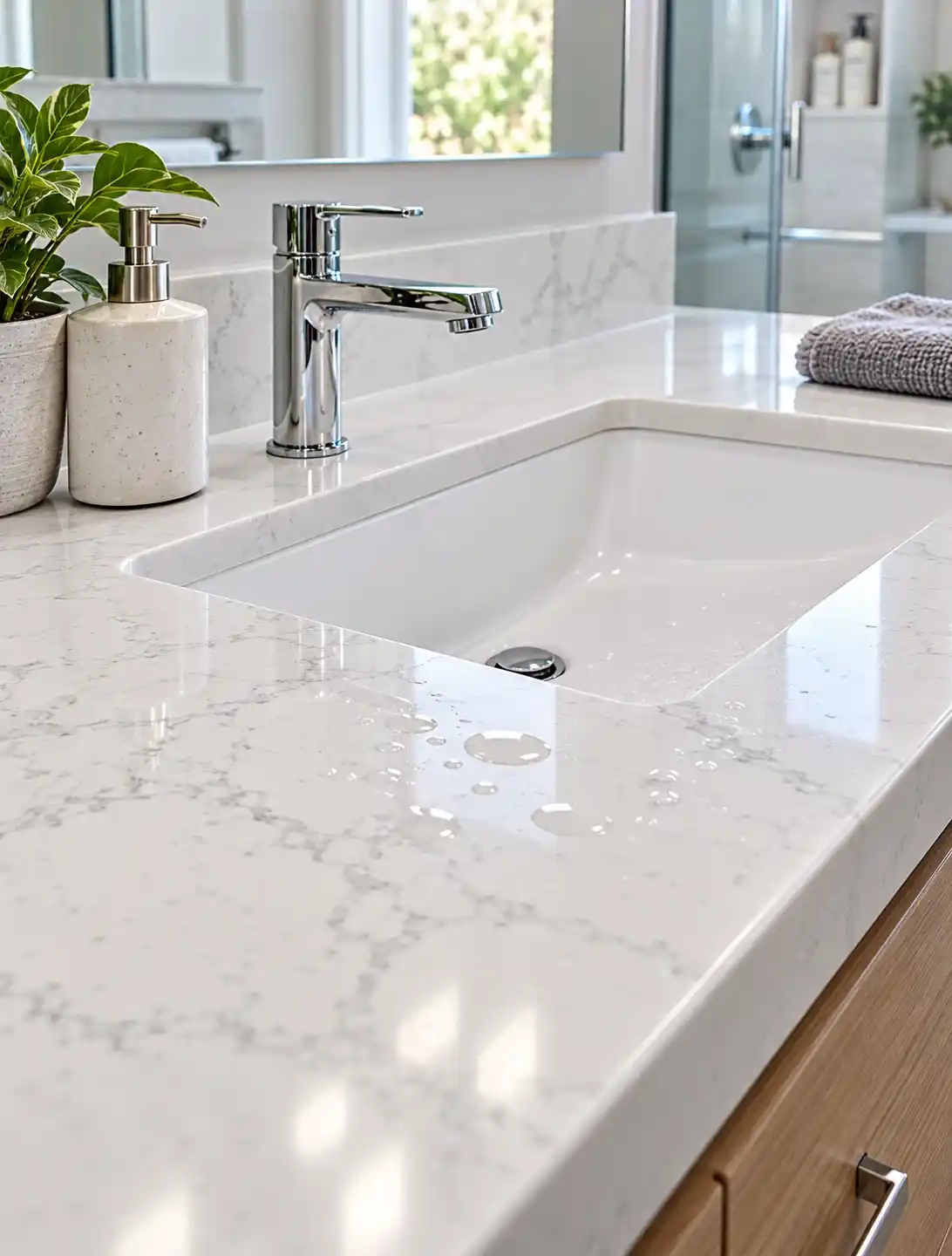
Access (stairs, upper floors), city and slab choice move the numbers too. Ask about remnants, because a bathroom top often fits an offcut.
Regional note (US/UK/CA/AU): UK and Canadian quotes tend to land near US figures after currency conversion. Australian quotes tend to run higher on labour and import costs, and with engineered stone banned you’ll be quoted natural stone, porcelain or solid surface.
If the plumber is also moving pipes, that’s a separate cost line entirely, so budget for it on its own.
Which one should you choose?
Pick by situation, not by reputation.
- Lowest upkeep, no sealing → quartz (where available).
- Natural variation and heat tolerance, and you don’t mind sealing → granite.
- Integrated sink and fewer joints → solid surface.
- Rental, investment property or accessible household → solid surface: repairable and seamless.
- Floating vanity with unconfirmed backing → solid surface (lighter), or confirm backing first.
- Australia → granite, solid surface or porcelain slab (verify rules).
- Tight budget → prefab top or remnant.
- Planning to cut or template it yourself → don’t. Use a fabricator.
Where DIY stops: Fabrication, cutting and templating belong to the fabricator. Removing the old top and prepping the cabinet are fair game. Bring a plumber in for reconnection and an electrician for outlets. One last resale thought: in a rental or starter home, premium stone rarely pays you back, while in a home buyers will inspect closely it reads as quality.
Bathroom countertop FAQs
Is quartz or granite better for a bathroom vanity top?
For most households, quartz, because it’s non-porous and never needs sealing. Granite is a solid alternative if you want natural variation and better heat tolerance and don’t mind occasional sealing. In a bathroom the gap between them is small, so cutouts, support and price often decide it. Pick the one you can actually buy and have installed well locally.
Does granite need sealing in a bathroom, and how often?
It depends on the stone, because porosity varies. Try the water-drop test: if a few drops darken the surface within a few minutes, it’s time to reseal. Many tops need it roughly once a year, though denser stones can go longer. Follow your fabricator’s advice, and clean and dry the surface first or the sealer won’t take.
Is quartz still available in Australia?
Engineered stone, which covers most quartz countertops, has been banned from manufacture, supply and installation in Australia since 1 July 2024, with limited exceptions such as removal and repair. Ask your fabricator about natural stone, porcelain slab or solid surface instead. Rules can change, so verify the current position with your local authority.
Is solid surface a good bathroom countertop, and can scratches be repaired?
Yes. It’s non-porous, can be formed with an integral sink and coved backsplash, and is lighter than stone. Surface scratches can often be sanded out and polished, which suits rentals and busy households. The trade-off: it scratches more easily than stone and can mark under direct heat, so keep a heat mat under hair tools.
Can I put a stone top on any vanity, including a floating one?
Not automatically. Stone is heavy, so the cabinet has to be level, solid and well fixed. A floating vanity hangs its whole load from the wall, so you need confirmed backing and rated brackets. If you can’t confirm that, choose something lighter like solid surface, or have a builder check before you order.
Can I install a stone vanity top myself?
Leave fabrication, cutting and templating to professionals; the dust hazard and the cost of one wrong cut are both real. A confident DIYer can remove the old top, prep the cabinet and check it’s level. Bring in a plumber for disconnect and reconnect if you’re unsure, and an electrician to confirm outlet positions near the basin.
.webp)
.webp)