Quick answer: Soft whites, warm greiges, pale blue-grey, and light sage make a bathroom look bigger and brighter — especially in a near-monochromatic scheme carried from walls to floor. But color is only half the story. Grout tone, tile format, and lighting temperature do as much visual work as the paint chip you agonized over, and most articles skip that part entirely.
If you’ve ever repainted a small bathroom “the right color” and still felt like you were standing in a box, you’re not imagining it. The color wasn’t wrong. Something around it was.
.webp)
The Real Mechanism — Why Some “Light” Colors Still Look Small
Here’s what most bathroom color guides leave out: a color’s actual brightness isn’t just about how light it looks on the chip. Paint and tile manufacturers print a Light Reflectance Value (LRV) — a number from 0 (absolute black) to 100 (pure white) that tells you how much light a color actually bounces back into the room. Two colors can both look “light neutral” sitting next to each other on a fan deck, but one might sit at 72 LRV and the other at 54. In a small windowless bathroom under a single 60-watt bulb, that gap is the difference between a room that photographs bright and one that just looks flat and slightly grey by 7 p.m.
Undertone matters just as much. A “warm white” that reads perfect in the paint aisle can turn cold and faintly grey the moment it’s next to your existing oak vanity or beige floor tile that isn’t getting replaced. This is the single most common reason people repaint a bathroom, hate it within a year, and assume the color itself was the problem. It usually wasn’t — it clashed with something already in the room.
Most homeowners don’t realize the bulb already installed in their bathroom is doing more to determine how “bright” their color choice looks than the color itself. A cool 5000K bulb on a warm greige wall will fight the paint. A warm 3000K bulb on the exact same wall will make it glow.
.webp)
The Best Colors, Ranked by Room Type
Not every bathroom needs the same fix. The right palette depends on what kind of small or dim room you’re actually dealing with.
Windowless powder rooms or interior bathrooms
Skip stark, cool white — without daylight to balance it, it can look flat and clinical under artificial light. Warm white or soft greige (something in the 65–75 LRV range with a warm undertone) performs better here because it holds its brightness under artificial bulbs instead of relying on daylight it doesn’t get.
Small bathrooms with a single window
This is where a near-monochromatic scheme — walls, floor, and vanity kept within the same tonal family — does the most work. Removing the visual “stop points” where one color ends and another begins makes the actual footprint read larger than it is.
North-facing bathrooms (cooler, flatter daylight)
North light tends to be cooler and bluer. A wall color with a warm undertone (soft ivory, warm greige, pale blush-beige) counteracts that flatness. A cool grey or icy white in a north-facing room can look almost bluish-dim by mid-afternoon.
South-facing or skylit bathrooms
You have more room to experiment. Pale sage, dusty blue, or a soft warm grey all work well here because there’s enough natural daylight to keep the color from reading dark, even with slightly lower LRV values than you’d want in a windowless room.
Bathrooms with dark or warm existing flooring you’re not replacing
Don’t fight it with a cool white — it will look grey and slightly off. Lean into a warm neutral or soft greige wall color that pulls the same undertone as the floor, so the whole room feels intentional instead of mismatched.
.webp)
Style Comparison — Which Light Palette Fits Your Bathroom
| Style | Defining Features | Cost Tier | Maintenance | Best Room Size | Resale Appeal | Trend Longevity |
|---|---|---|---|---|---|---|
| All-White Modern | Crisp white walls, white or pale grey tile, chrome or nickel fixtures | $ | Medium — shows water spots and scuffs quickly | Small to mid | High — broadly appealing | High, but can feel sterile under weak lighting |
| Warm Neutral (Greige/Taupe) | Warm-undertone walls, soft taupe or oak-toned accents | $–$$ | Low-medium — hides everyday marks better than stark white | Small to large | High | Very high — softer than trend-driven white |
| Soft Pastel (Sage/Pale Blue) | Muted sage or dusty blue walls, white trim | $–$$ | Medium | Small to mid | Medium-high | Medium-high — currently trending, likely to age gracefully if kept muted |
| Monochromatic Light Scheme | Same or near-same tone across wall, floor, vanity | $$ | Medium — light grout needs upkeep | Small (most effective here) | High — reads intentional | High |
| Bold/Dark Accent | One dark tiled wall or niche, light floor, warm lighting | $$–$$$ | Medium-high | Small to mid, if lit well | Medium — polarizing but photogenic | Medium — muted tones (forest green, charcoal) outlast trend colors |
A monochromatic light scheme is usually the safest bet for a genuinely small room. But don’t let the “safe” column talk you out of contrast entirely — more on that below.
.webp)
Grout, Tile Size, and Finish — The Part Everyone Skips
You can pick the technically correct paint color and still end up with a bathroom that looks smaller than it should, because the tile and grout decisions undo the color work.
| Design Element | Best Choice | Why | Common Mistake | Maintenance Reality |
|---|---|---|---|---|
| Flooring tile | Large-format (12”×24”+) light porcelain, matte-to-satin | Fewer grout lines, wider reflective surface | Small light mosaic — grout grid cancels the effect | Satin resists slips better than gloss; mop weekly |
| Wall tile | Glossy or satin, warm white or pale grey | Gloss reflects light directly | Busy pattern “because it’s light-colored” | Gloss shows water spots faster; squeegee after showers |
| Grout color | Within 1–2 shades of the tile | Matching grout removes the visible grid | Dark grout on light tile — creates a shrinking grid effect | Light grout stains faster; seal every 12–18 months |
| Vanity finish | Light wood or painted warm white | Keeps the largest furniture piece from anchoring the eye | Dark espresso vanity in a light room | Painted edges chip near the basin; wood needs occasional resealing |
| Mirror | Oversized, ideally wall-to-wall | Doubles the perceived light source | Undersized mirror centered over the sink | Anti-fog backlit types reduce streaking |
| Lighting | Layered, 3000–3500K warm-white | Reads brighter and more flattering than cool white | Single overhead fixture — creates shadows | Replace bulbs as a matched set |
Grout deserves its own callout here because it’s the variable almost nobody budgets time for. Dark grout on light tile creates a visible grid across the floor or wall — and that grid, not the tile color, is often what makes a “light” bathroom still read small in photos.
.webp)
Design Mistakes That Undo a Bright Palette
- Painting walls fresh but leaving yellowed trim untouched — the mismatch reads dingy even with new wall color.
- Choosing a paint swatch under store lighting and skipping a test patch under your own bathroom’s bulbs.
- Using dark or contrasting grout with light tile “for definition” — it visually chops up the surface.
- Installing a small, centered mirror instead of an oversized one — the cheapest brightening upgrade, consistently under-sized.
- Relying on a single harsh overhead light — creates shadows that make even a well-chosen color look uneven.
- Choosing high-gloss white floor tile in a household with kids or pets — it shows every hair and water spot, and the maintenance frustration often leads to a regretted re-tile.
- Matching the shower curtain, bath mat, and towels exactly to the wall color — a fully matched room can look flat rather than bright.
- Leaving a dark vanity untouched while repainting everything else light — it becomes the heaviest object in the room.
- Skipping the exhaust fan upgrade when repainting — poor ventilation causes light paint to yellow or shadow with faint mildew along the ceiling within 1–2 years.
- Assuming any light color fixes a genuinely dark, windowless bathroom — in true low-light rooms, the lighting fixture does more work than the wall color ever will.
.webp)
What This Actually Costs
You don’t need a full renovation to get most of this effect. Here’s a realistic 2026 breakdown by budget tier for a small bathroom.
| Cost Category | Budget Tier ($) | Mid Tier ($$) | Premium Tier ($$$) |
|---|---|---|---|
| Floor tile | $2–$4/sq ft | $5–$9/sq ft | $10–$20+/sq ft |
| Wall tile | $1.50–$3/sq ft | $4–$8/sq ft | $9–$18/sq ft |
| Vanity | $150–$350 | $400–$900 | $1,000–$2,500+ |
| Fixtures | $80–$150 | $200–$450 | $500–$1,200 |
| Lighting | $60–$150 | $180–$400 | $450–$900+ |
| Mirror | $50–$120 | $150–$350 | $400–$900+ |
| Labor | DIY paint refresh: $0–$300 in supplies | $1,500–$3,500 partial retile | $4,000–$9,000+ full retile |
| Estimated Total | $300–$900 | $3,000–$6,500 | $7,000–$16,000+ |
If your budget lands in the first column, spend it on paint, a grout refresh, an oversized mirror, and better bulbs before you touch the tile. That combination delivers most of the visible difference for a fraction of the cost of a full retile.
Can a Dark Accent Still Work in a Small Bathroom?
This is where most articles get too simplistic. “Light = big, dark = small” isn’t really a rule — it’s a shortcut that only holds up when everything else in the room stays weak.
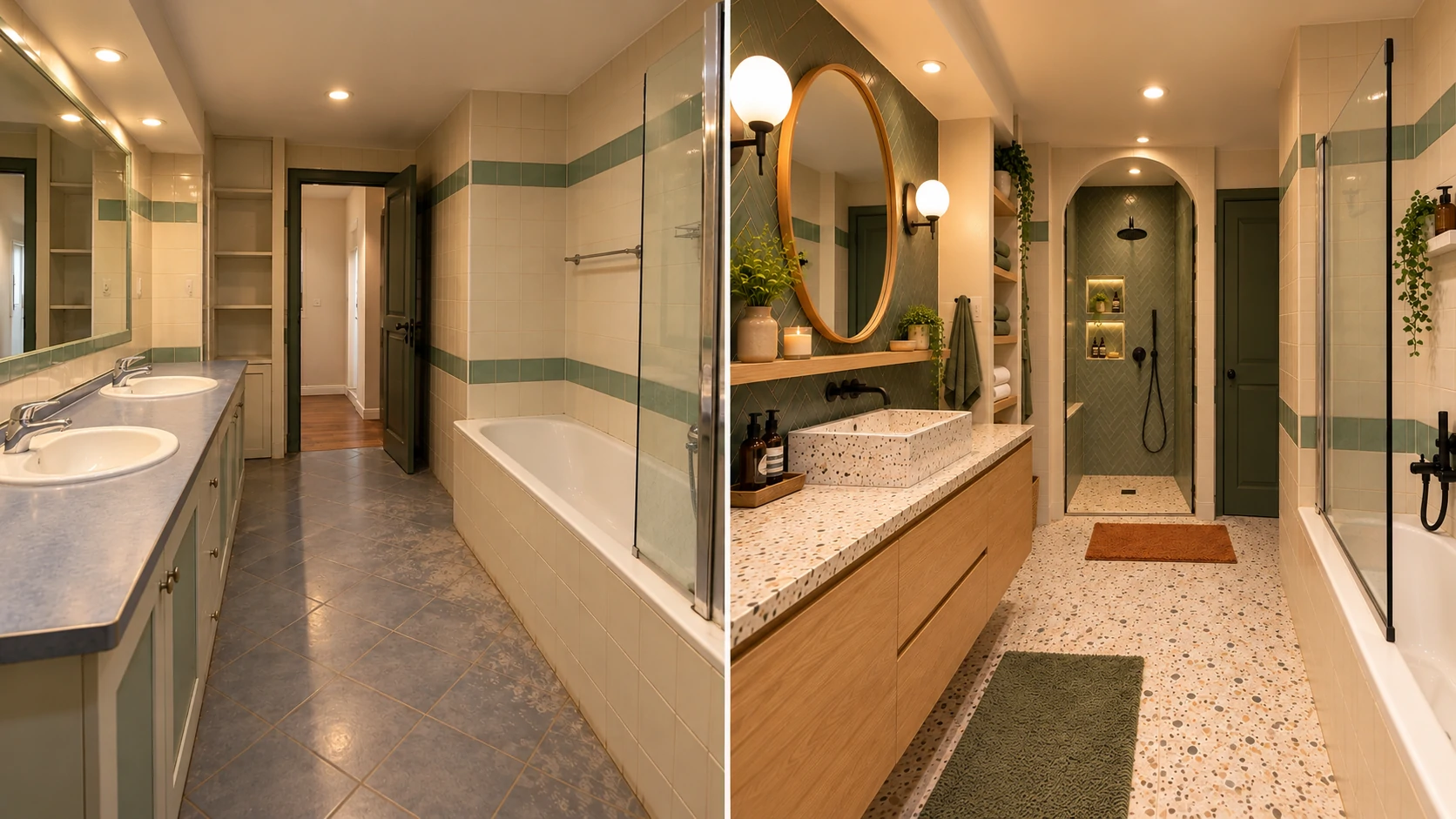
I recently walked through a bathroom that made this obvious. The before was a fairly typical dated setup: grey floor tile, beige-and-white wall tile with a sage accent stripe running around the room, and a single overhead downlight doing all the work. On paper, it was a light-ish, neutral bathroom. In person, it felt closed-in and a little cave-like — the lighting was too weak and too uneven to make any of that “light” color actually read as bright.
The after wasn’t all-white. It went the other direction on one wall — a saturated dark green herringbone tile running floor to ceiling in the shower. But the rest of the room stayed deliberately light: a pale speckled terrazzo-look floor, soft off-white walls, and layered warm-toned wall sconces flanking an oversized mirror. The result reads more spacious than the “safer” before version did, not less. The dark tile became a focal point instead of a wall closing in on you, because the floor stayed light and the lighting more than doubled.
The takeaway isn’t “go dark.” It’s that a bold color and a spacious-feeling room aren’t mutually exclusive — the floor tone and the lighting are doing the heavy lifting either way.
⚠️ Warning: Undertone clash is the #1 reason people repaint within a year. A “warm white” that looks perfect on a paint chip can read cold and slightly grey next to warm oak flooring or a beige tile you’re keeping. Always test a sample against what’s staying in the room — not just against the wall.⚠️ Warning: Paint sheen matters as much as color. Flat or matte absorbs both humidity and light. Satin or semi-gloss is the realistic minimum for bathroom walls — it survives the humidity and reflects more light.
DIY vs. Calling a Pro
Most of what actually moves the needle here — paint, grout refresh, a new mirror, updated lighting fixtures, bulb swaps — is well within reach for a confident DIYer over a weekend. None of it requires moving plumbing or touching structural elements.
Where it’s worth calling a professional: full tile replacement (especially anything involving waterproofing behind the tile), any electrical work beyond a straightforward fixture swap, and moving a vanity or plumbing fixture to a new location. Botched waterproofing behind new tile is one of the most expensive mistakes to fix after the fact — it’s not the place to save money on labor.
Maintenance Reality of a Light Palette
A brighter bathroom takes slightly more upkeep than a dark, forgiving one. That’s a fair trade for most people, but it’s worth knowing going in.
| Task | Frequency | Difficulty | Notes |
|---|---|---|---|
| Squeegee glossy tile/walls | After each shower | Easy | Biggest factor in keeping a light glossy scheme looking bright long-term |
| Re-seal light grout | Every 12–18 months | Easy–Medium | Light grout stains faster than dark |
| Deep clean grout lines | Monthly | Medium | Use pH-neutral cleaner to protect matte finishes |
| Repaint high-touch trim | Every 3–5 years | Medium | Trim scuffs and dulls before wall paint does |
| Clean/replace exhaust fan filter | Every 6 months | Easy | Prevents ceiling-line yellowing |
| Check caulk for yellowing | Every 6–12 months | Easy | Yellowed caulk is one of the fastest ways a bright bathroom starts looking dated |
| Polish mirror and fixtures | Weekly / monthly | Easy | Dust and water spots quietly dull the reflective effect you paid for |
”Which Palette Fits My Bathroom?” Quick Self-Check
- No window or a very small one → Prioritize lighting temperature and mirror size over the exact wall color.
- Kids or pets in the house → Avoid high-gloss white flooring; choose a warm greige or satin-finish light tile.
- Renting or planning to move soon → Stick to paint-only changes — most of the effect comes from these lower-cost levers anyway.
- Selling within 2–3 years → Favor warm neutral or monochromatic light schemes over trend colors for broader buyer appeal.
- Existing dark or warm flooring you’re keeping → Choose a warm-undertone wall color, not a cool stark white.
- Want a design statement, not just “safe” → A single dark accent wall can work, as long as the floor stays light and the lighting is strong.
- Working with a tiny powder room → Monochromatic light schemes perform best; multiple colors or materials tend to shrink a very small footprint further.
- Budget under $500 → Spend it on paint, grout refresh, an oversized mirror, and bulb temperature before touching the tile.
FAQ
What is the single best color to make a small bathroom look bigger? There’s no one universal answer, but warm white and soft greige consistently perform best because they carry a high light reflectance value while hiding everyday marks better than stark white. The bigger factor than the exact shade is consistency — carrying the same tone across walls, floor, and vanity avoids the visual breaks that make a small room feel chopped up.
Will a dark accent wall make my small bathroom feel cramped? Not necessarily. A single dark wall or tiled niche can work if the floor stays light and the lighting is strong and warm-toned. The problem isn’t dark color itself — it’s dark color combined with weak lighting and a dark floor, which together remove the visual “escape points” that keep a room feeling open.
Should bathroom wall color match the floor tile? Matching or near-matching tones generally makes a small bathroom feel larger, since it removes the visual line where one surface stops and another begins. A stark contrast between a very light wall and a very dark floor tends to visually shrink the room.
Is white still the best bathroom color in 2026, or is it dated? All-white remains broadly appealing and safe for resale, but warm neutrals and soft muted tones have gained ground because they photograph just as bright while feeling less clinical. All-white isn’t dated — pairing it with warm wood tones and layered lighting simply reads more current than stark white with cool chrome alone.
Can paint alone brighten a bathroom with no window? Paint helps, but in a windowless bathroom, lighting temperature and fixture placement do more of the actual work than color. A light wall color under a single weak overhead bulb will still look dim; the same color under layered, warm-white lighting and a large mirror reads noticeably brighter.
Does light grout require more maintenance than dark grout? Yes. Light grout stains and discolors faster than dark grout without regular sealing. It’s a real trade-off: light grout supports the “bigger and brighter” effect better than dark grout on light tile, but it needs resealing roughly every 12–18 months to stay looking fresh.
What’s the cheapest way to make a bathroom look bigger without retiling? Repainting walls and trim in a consistent light, warm-toned color, refreshing the grout, upgrading to a larger mirror, and switching to warm-white layered lighting typically costs a few hundred dollars and delivers most of the visual impact of a full retile.
.webp)
 (2).webp)
.webp)
.webp)