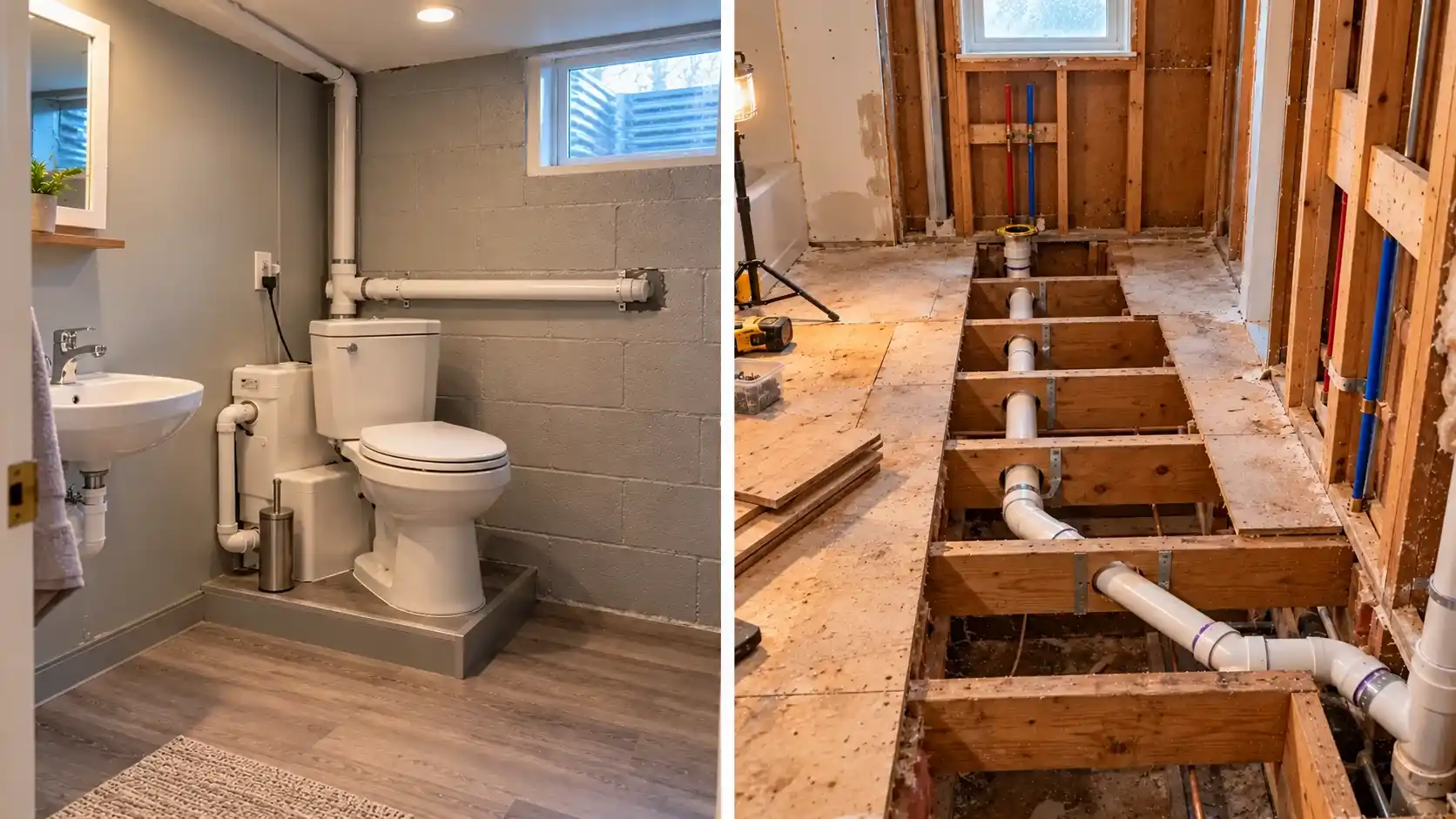
Short answer: Estimated cost to move bathroom plumbing: roughly $500–$1,500 for a short move over a timber floor, and $2,500–$8,000+ when a toilet drain must be relocated through a concrete slab. Drain distance, floor construction, and access drive the price.
Almost any fixture can be moved. The better question is whether your house makes it cheap, painful, or not worth doing, and a floor plan can’t answer that. It shows where you’d like the toilet. It doesn’t show the stack, the joists, or the slab. This guide is built around what a plumber checks on site rather than what looks tidy on paper.
Quick takeaways
- Drain and stack position set the price more than the fixture does.
- A timber floor with access from below is the cheapest case. A concrete slab is the dearest.
- A few inches is cheap. Crossing joists or changing walls can add thousands.
- Changing your mind on paper costs almost nothing. After tiling, the same change can cost several times more.
- Ask for an itemised quote, because “plumbing only” figures usually leave out the repair work.
%20(7).webp)
Why the drain, not the fixture, sets the price
Toilets are the fussy ones. They need the biggest drain in the room, a vent, and a pipe that falls steadily toward the stack. That fall is the catch: the farther you move, the lower the pipe sits in the floor, and a joist bay only has so much depth to give.
Most homeowners don’t realize that distance is a poor guide. Moving a toilet two feet across the joists can cost more than moving it six feet along a clear bay, because crossing joists means rerouting or notching. Sinks are far more forgiving. Shower drains sit in between: the pipe is smaller, but the slope has to hide inside the floor build-up, and the waterproofing and tile get disturbed. Moving a fixture also changes its vent path. Air admittance valves help in some jurisdictions and are restricted in others, so ask early.
| Change | Rating | What decides it | Who | Relative cost |
|---|---|---|---|---|
| Sink along the same wall | Easy | Reach within the same stud bay | Plumber | Low |
| Sink to another wall | Moderate | New drain and vent path | Licensed plumber | Low to mid |
| Toilet, short move near the stack | Moderate | Joist direction, vent access | Licensed plumber | Low to mid |
| Toilet across the room or to another wall | Hard | Slope, joist crossings, venting | Plumber, carpenter | Mid to high |
| Toilet on a concrete slab | Hard | Cutting, trench, slab type | Plumber, concrete crew | High |
| Shower drain, timber floor | Moderate | Joist depth, waterproofing | Plumber, tiler | Low to mid |
| Shower drain, slab | Hard | Recess depth, trench, re-pour | Plumber, concrete crew, tiler | Mid to high |
| Stack or whole-bathroom relocation | Structural | Joists, framing, vent route | Plumber, builder, maybe an engineer | Highest |
Rules differ by region. US codes (IRC/IPC) generally call for at least a 3-inch toilet drain and a steady fall, commonly 1/4 inch per foot on smaller drains. The UK (Approved Document H), Canada (National Building Code plus provincial codes), and Australia (NCC and AS/NZS 3500) cover the same ground in their own terms. Verify with your local building authority.
%20(5).webp)
What will each type of move actually cost?
These are estimated ranges in USD, not quotes. Get at least two itemised local quotes before you trust any number, including these.
| Item | Low | Typical | High | What moves the number |
|---|---|---|---|---|
| Sink along the same wall | $300 | $600 | $1,200 | Reach, wall access |
| Sink to a different wall | $600 | $1,200 | $2,500 | New drain and vent path |
| Toilet, short move (timber floor, access below) | $500 | $1,200 | $2,500 | Joist direction, flange position |
| Toilet across the room (timber floor) | $1,500 | $2,800 | $5,000 | Run length, joist crossings |
| Toilet on a concrete slab | $2,000 | $4,000 | $8,000+ | Cutting, trench, slab type |
| Shower drain (timber floor) | $500 | $1,200 | $2,500 | Floor depth, waterproofing rework |
| Shower drain (slab) | $1,500 | $3,000 | $6,000 | Recess, trench, re-pour |
| Supply lines only (hot and cold) | $300 | $800 | $1,800 | Pipe material, wall access |
| Stack or bathroom to another area | $3,000 | $6,000 | $12,000+ | Structure, vent route, floors affected |
| Make-good and permits | $300 | $1,000 | $3,000+ | Finished surfaces, local fees |
The last row is the one people skip. Floor patching, the ceiling below, and inspection fees rarely appear in a plumber’s number.
The spread comes from access, slab versus timber, your city, and the length of the pipe run. Directionally, UK jobs are quoted in pounds and often land close to the dollar figure for small work. Canada varies by province. Australia tends toward the upper end because of licensed labour and the number of slab-on-ground homes. Treat all of that as a starting point, not a forecast.
What happens when you change your mind after the tile is down?
This is where budgets break. Say you decide to move the toilet to the opposite wall. The plumbing is identical at every stage. What changes is how much finished work sits on top of it.
| Stage | What it involves | Estimated cost | Why |
|---|---|---|---|
| On paper | Redraw the plan, get a plumber’s site visit | $0–$200 | Time and perhaps a call-out fee |
| At rough-in, before surfaces close | Plumber runs new drain, vent, and supply | $1,500–$4,000 | Pipework is exposed |
| After tile and waterproofing | Open the floor, move pipes, re-tile, redo the membrane, re-inspect | $4,000–$10,000+ | You pay for the move plus the destruction |
Estimates for a timber floor. Drivers: access, tile and membrane cost, re-inspection fees.
A pattern that comes up constantly in homeowner threads: the toilet “feels wrong” once the room is framed, and the fix is requested after the waterproofing is done. Walk the framed room with the plumber before anything gets closed. It’s the cheapest hour of the project.
%20(1).webp)
What demolition reveals that a floor plan can’t
Old houses are full of surprises: cast-iron stacks that crumble when touched, galvanised supply lines clogged from the inside, open-web trusses nobody can cut, slabs with reinforcing you didn’t know about. Two inexpensive checks often pay for themselves: a camera inspection of the main drain line, and a concrete scan before anyone cuts a slab. Some slabs contain post-tension cables, and cutting one is dangerous.
Before you commit, confirm:
- Floor type, and what sits below it.
- Stack and main line location, plus pipe material and age.
- Joist direction, spacing, and type (solid timber, I-joist, truss).
- Access from below, or whether the ceiling underneath must be opened.
- Wet wall contents: stack, vents, supply, wiring, any flue.
- Vent route for the new position.
- Shut-off valves tested before demolition, since old ones can fail when turned.
- Slab details: as-built drawings if you have them, plus a scan.
- Permit and inspection hold points, so nothing is closed up too early.
- An itemised quote separating plumbing, carpentry, tile, waterproofing, and make-good.
%20(8).webp)
Where DIY ends and a licensed plumber starts
DIY is realistic for the prep: choosing fixtures, clearing the room, and sometimes swapping a vanity onto existing connections. Drains, vents, and anything cut into a slab belong to a licensed plumber, and in most places they also need a permit. Check what applies to you:
- US: permit and licensing rules vary by state and city.
- UK: drainage changes may involve Building Control, and water-supply work should be done by a competent person.
- Canada: permits are generally required for drainage alterations, and licensing is set by province.
- Australia: sanitary plumbing must be done by a licensed plumber, and a compliance certificate is typically required. Wet-area waterproofing has its own standard (AS 3740).
Verify all of this with your local authority.
⚠️ Warning: Don’t notch or drill joists to squeeze in a bigger drain without checking local rules and getting professional advice. It’s a common shortcut, and it can weaken the floor. I-joists and trusses usually can’t be cut at all.⚠️ Warning: A plumbing quote is not a renovation budget. If it doesn’t mention floor repair, ceiling repair, tile, waterproofing, and permits, expect those costs to show up later.⚠️ Warning: Don’t close the floor or wall until new pipework has been pressure-tested, flow-tested, and inspected where required. A slow drain found after tiling means tearing it out again.
%20(2).webp)
Move it or leave it? A quick decision guide
- Timber floor, access from below, new spot near the stack → usually reasonable. Get quotes.
- Slab, and you only want a few extra inches → don’t move the toilet. Adjust the vanity size or door swing instead.
- Slab, and you want the toilet on the opposite wall → price the slab work, then compare it with moving the vanity or shower.
- Shower drain must move, shallow floor build-up → ask about a raised platform or a linear drain along the same wall.
- Stack on the wrong side, room below finished → budget for opening the ceiling, or keep the toilet and relocate other fixtures.
- Below the sewer line, as in a basement → consider an upflush system.
- Selling or investing → move plumbing only when it adds real function or a buyer-counted bathroom.
- Quote far above these ranges → ask which of slab, stack, structure, or make-good is driving it.
%20(16).webp)
Moving bathroom plumbing: questions homeowners ask
Is it cheaper to move a toilet or a shower drain?
Neither is always cheaper, because it depends on the floor and the distance. A toilet is driven by pipe size, venting, and stack distance. A shower drain needs slope inside the floor build-up and often triggers waterproofing and tile rework. On a timber floor with access from below, short moves for either can cost about the same. On a slab, both usually involve cutting concrete.
Can I move a toilet to the other side of the room on a concrete slab?
Usually yes, but it’s one of the pricier moves. The plumber locates existing lines, cuts the slab, runs a new sloped drain and vent, backfills, and the concrete is re-poured. Scan first, because some slabs hide reinforcing or post-tension cables. Compare the price against keeping the toilet put and moving the vanity or shower.
How far can you move a toilet from the stack?
There’s no single safe number. The limit depends on drain size, the slope you can achieve in the available floor depth, and local venting rules, such as trap-to-vent distances under the IRC/IPC or their UK, Canadian, and Australian (AS/NZS 3500) equivalents. A plumber or inspector should confirm the maximum for your house. Verify with your local building authority.
Do I need a permit or a licensed plumber to move bathroom plumbing?
In most places, altering drains and vents needs a permit and a licensed plumber, though rules vary. US requirements differ by state and city. In the UK, drainage alterations may involve Building Control. Canada generally requires permits, with licensing set by province. Australia requires a licensed plumber for sanitary plumbing. Verify locally.
Is an upflush or macerating toilet a cheaper alternative to moving the drain?
Sometimes. These units pump waste through a small-bore pipe to an existing drain, which helps where a gravity drain is impractical, such as a basement. The trade-offs are noise, maintenance, pump failure risk, and local code limits. They suit an extra toilet better than a main bathroom, so check your local rules.
%20(15).webp)
%20(3).webp)
%20(9).webp)
%20(10).webp)
%20(6).webp)
%20(12).webp)
%20(14).webp)
%20(4).webp)
%20(11).webp)
.webp)
 (1).webp)
 (1).webp)
.webp)
.webp)
.webp)