.webp)
In 2026, the most outdated bathroom trends are cold all-white or all-gray schemes, matte black fixtures everywhere, vessel sinks, tile countertops, faux wood-look tile, single accent walls, and overly matched sets. Designers now favor warm, textured, layered spaces that hold up to daily use.
That’s the short version. The longer version matters more, because “outdated” is one of those words that can talk you into spending $15,000 you didn’t need to spend.
A bathroom is not a living room. You can’t swap the tile the way you swap a throw pillow, and a wrong call on a countertop will annoy you every single morning for years. So this guide does two things. It tells you which looks have actually aged badly, and it tells you which of those are worth fixing, which are fine to live with, and which cheap changes get you 80% of the way to a current-feeling bathroom.
Quick takeaways
- Cold palettes are the biggest “dated” signal. All-white, all-gray, and icy blue rooms feel clinical. Warm neutrals, clay, cocoa, and soft greens are taking over.
- Matte black and vessel sinks look great in photos and cause the most complaints once you live with them. Water spots, splash, and cleaning around awkward bases are the usual culprits.
- A single feature wall and a perfectly matching fixture set now read as staged, not designed.
- Overhead-only lighting is out. Layered, dimmable, warm light is in, and it’s the cheapest big upgrade you can make.
- Paint, bulbs, a mirror, hardware, and a vanity top can modernize a bathroom for a few hundred dollars. Tile and layout are the expensive, hard-to-reverse decisions.
- “Outdated” does not mean “rip it out.” A clean, functional white bathroom is still a safe bathroom to own and to sell.
Why bathroom trends date faster (and hurt more) than any other room
Most homeowners don’t realize how unusual the bathroom is as a design problem.
In a bedroom, almost everything is swappable. Bedding, art, lamps, even the paint, all change over a weekend. In a bathroom, the most visible surfaces (tile, tub, vanity, countertop, floor) are glued, grouted, and plumbed in place. Changing them means demolition, waterproofing, and a week or more without a working shower.
That’s why a useful way to think about bathroom trends is by how hard each decision is to undo:
- Layout and plumbing (hardest)
- Tile and waterproofing
- Vanity and countertop
- Faucets and fixtures
- Lighting and mirror
- Paint, hardware, textiles, and accessories (easiest)
Be cautious at the top of that list and experiment at the bottom. If you take only one idea from this article, take that one. A bold paint color that dates in two years costs you a Saturday. A bold tile that dates in two years costs you a renovation.
The 12 outdated bathroom trends in 2026
Design publications have been remarkably consistent about what’s fading. One 2026 trends report from Fixr.com, which surveyed roughly 100 designers and home stagers, ranked all-white and all-gray bathrooms as the most-cited look losing momentum, well ahead of vessel sinks, tile countertops, wood-look tile, and matte black hardware. It’s a small sample, so treat it as one signal rather than gospel, but it lines up with what most design coverage is saying.
Here’s the list, with what actually happens when you live with each one.
1. All-white and all-gray color schemes
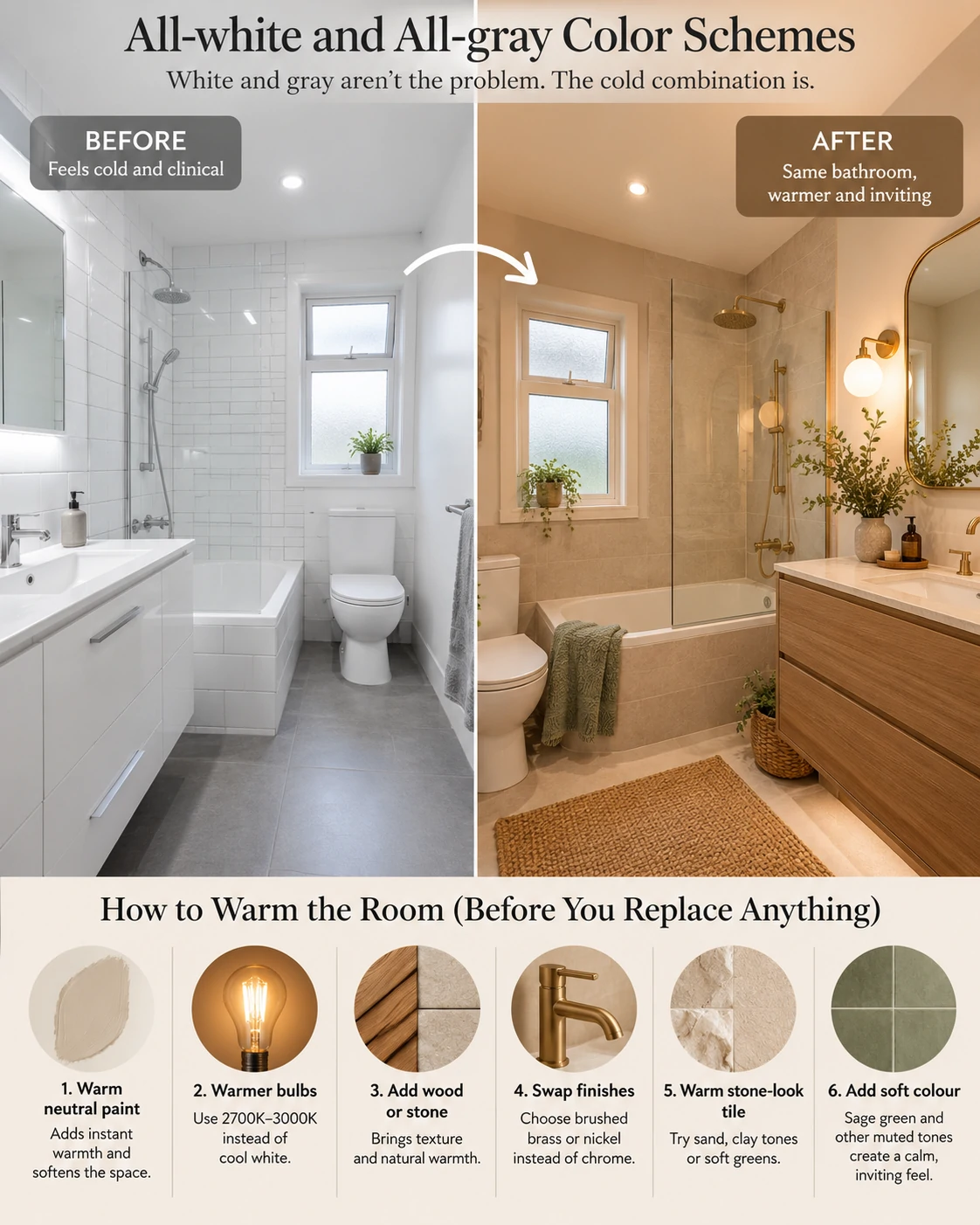
This is the big one. White tile, gray grout, chrome fixtures, a white vanity, and cool-white bulbs add up to a room that feels like a showroom or a clinic.
The thing most articles miss: white and gray aren’t the problem. The cold combination is. Cool-white light, gray grout, and zero texture make even good tile feel flat.
What to do instead: If the tile and tub are in good shape, warm the room before you replace anything. Repaint the walls in a warm neutral, switch to 2700K–3000K bulbs, add wood or stone, and swap chrome for brushed brass or nickel. For new projects, look at warm stone-look porcelain, sand and clay tones, and soft greens.
2. Matte black everything
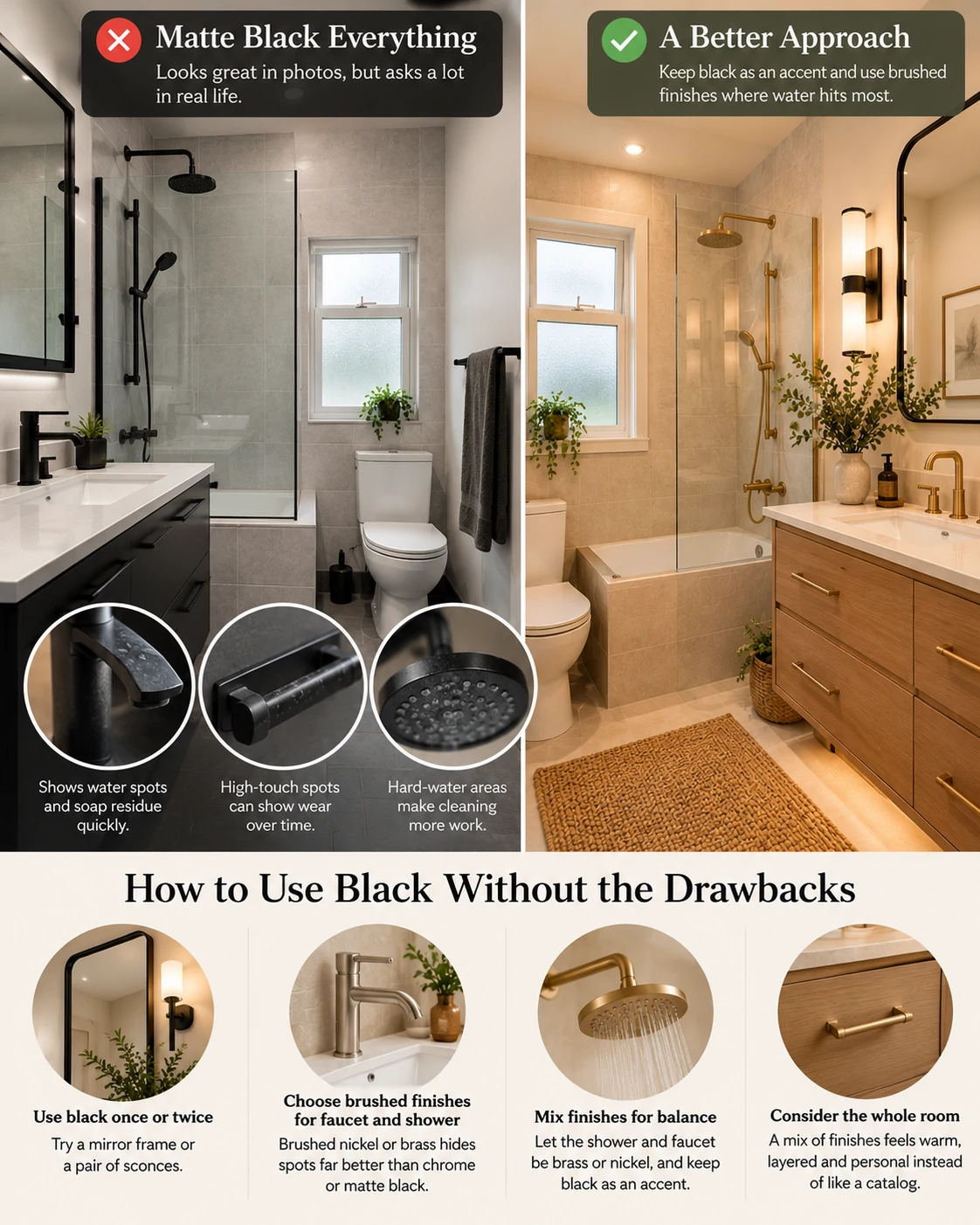
Matte black fixtures had a long run because they photograph beautifully. In a real bathroom, they ask a lot of you.
In hard-water areas, matte black shows water spots and soap residue quickly. High-touch spots like handles can show wear over time, depending on the finish quality. And when the faucet, showerhead, towel bar, mirror frame, and cabinet pulls are all black, the room starts to look like a catalog.
What to do instead: You don’t have to give up black. Use it once or twice (a mirror frame, a pair of sconces) and choose a brushed nickel or brass for the faucet and shower, where water hits most. Brushed finishes hide spots far better than either polished chrome or matte black.
3. Vessel sinks
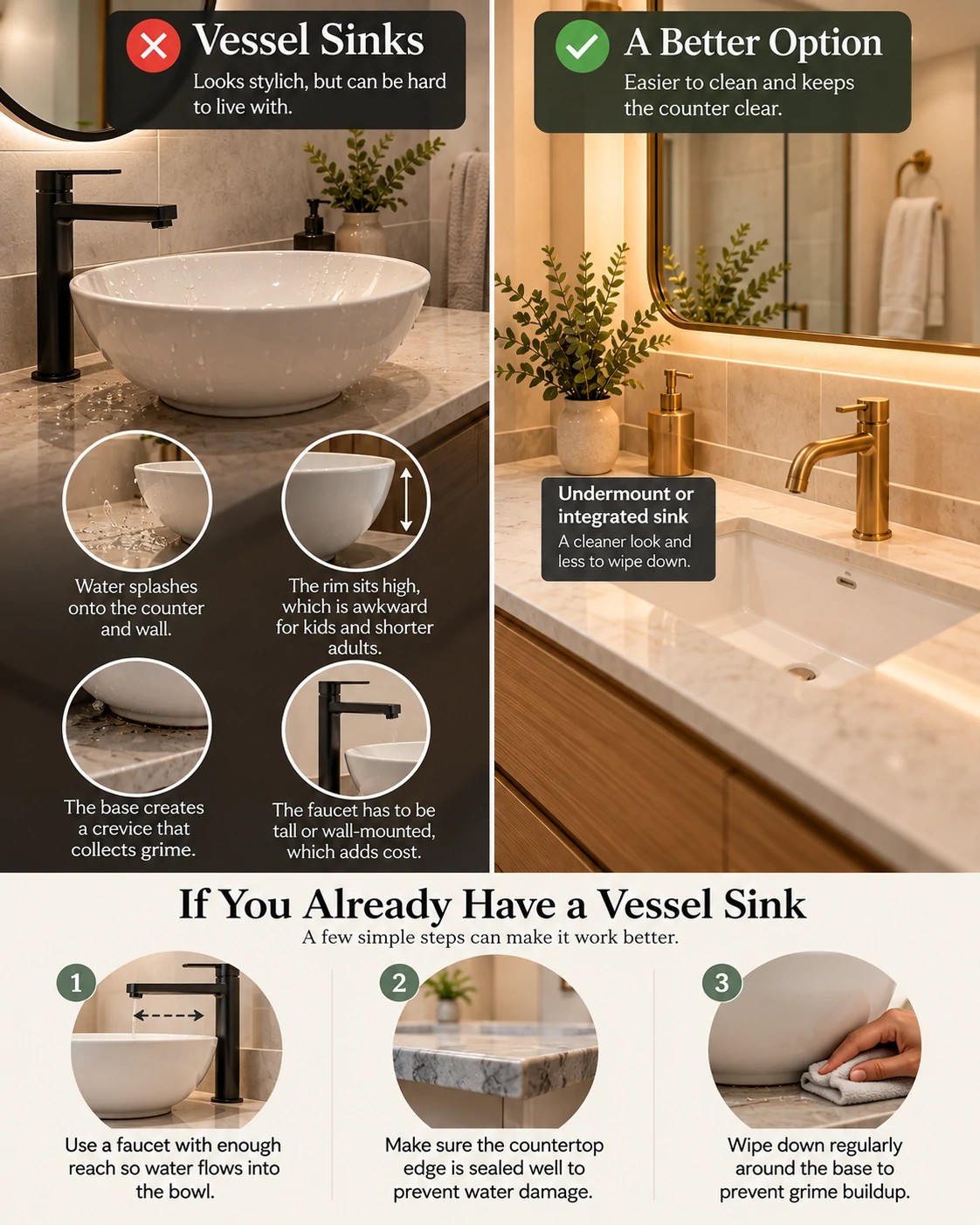
A bowl sitting on the counter looked like design in 2015. Living with one is a different story.
- Water splashes onto the counter and the wall behind it.
- The rim sits high, which is awkward for kids and shorter adults.
- The base creates a crevice that collects grime.
- The faucet has to be tall or wall-mounted, which adds cost.
What to do instead: An undermount or integrated sink is easier to wipe down and keeps the counter clear. If you already own a vessel sink and like it, a few things help: a faucet with enough reach, a countertop edge that’s sealed well, and a regular wipe-down around the base.
4. Tile countertops
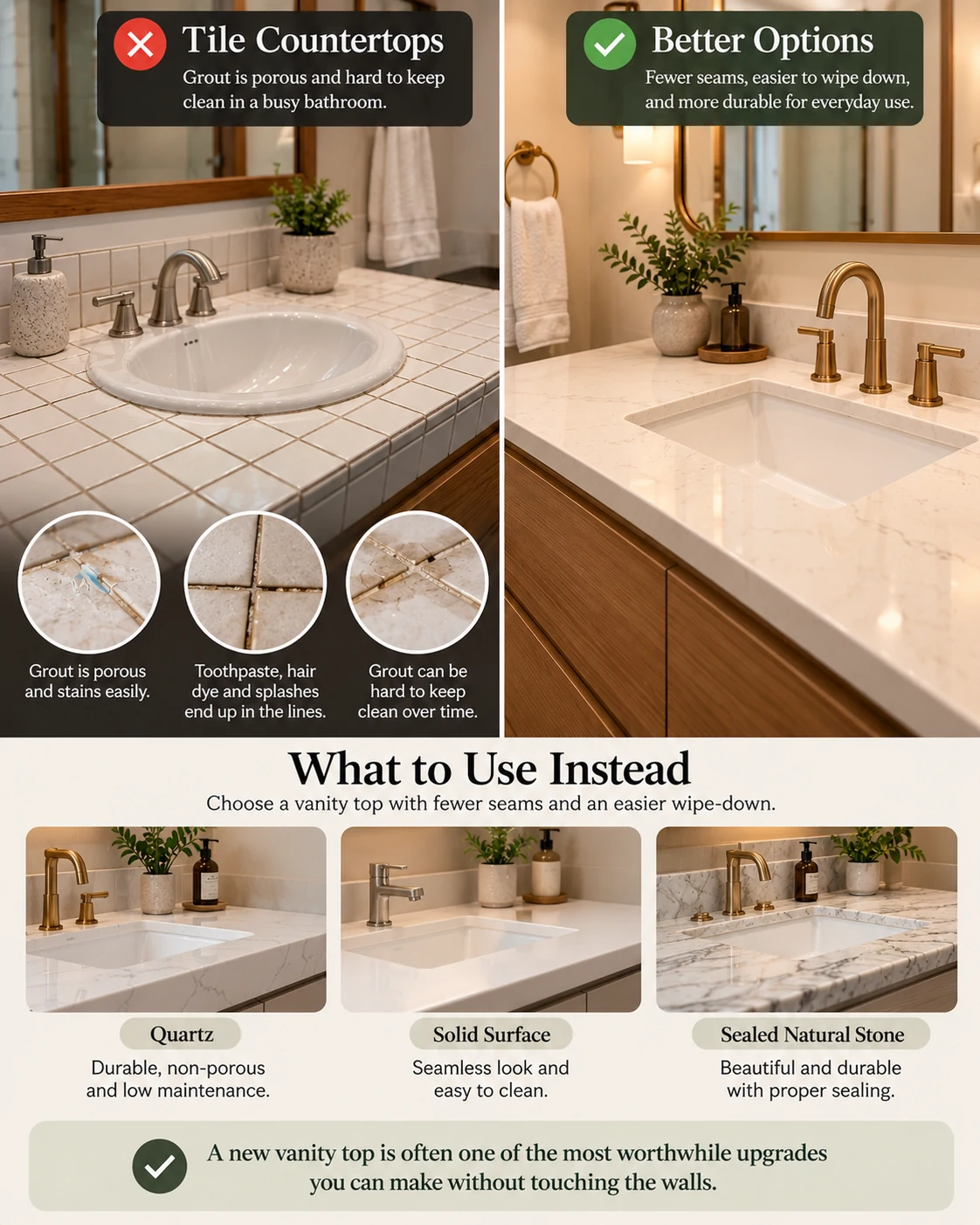
Grout is porous, and a vanity top is the busiest horizontal surface in the bathroom. Toothpaste, hair dye, and splashes all end up in those lines.
What to do instead: Quartz, solid surface, or sealed natural stone. All of them give you fewer seams and an easier wipe-down. A new vanity top is often one of the most worthwhile upgrades you can make without touching the walls.
5. Wood-look tile in showers
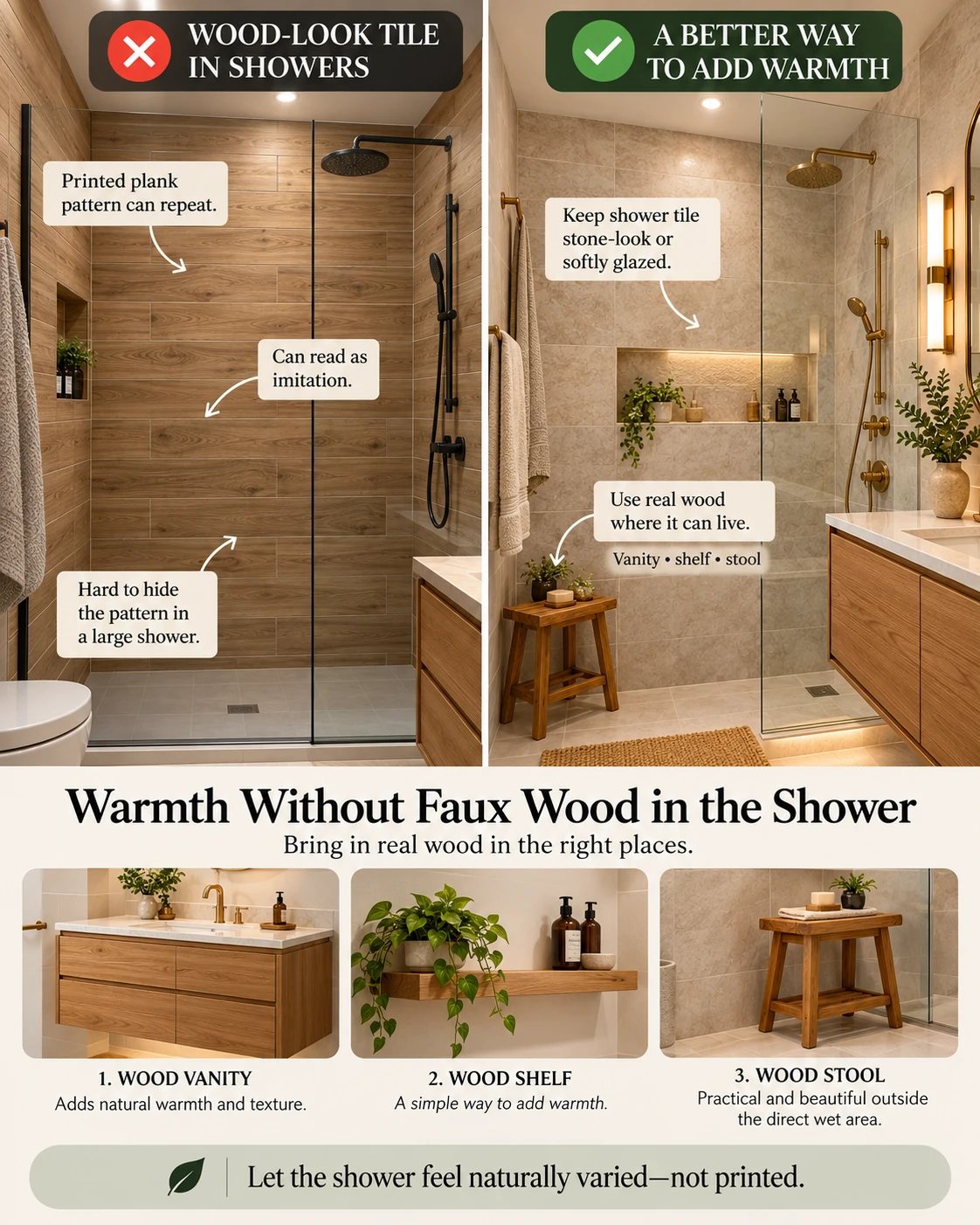
Faux wood tile had its moment, and a few designers still like it. But in shower walls it can read as an imitation, and the repeating pattern of printed planks is easy to spot.
What to do instead: If you want warmth, use real wood where it can live, like a vanity, a shelf, or a stool, and let the shower be stone-look or glazed tile with gentle variation.
6. The single feature wall
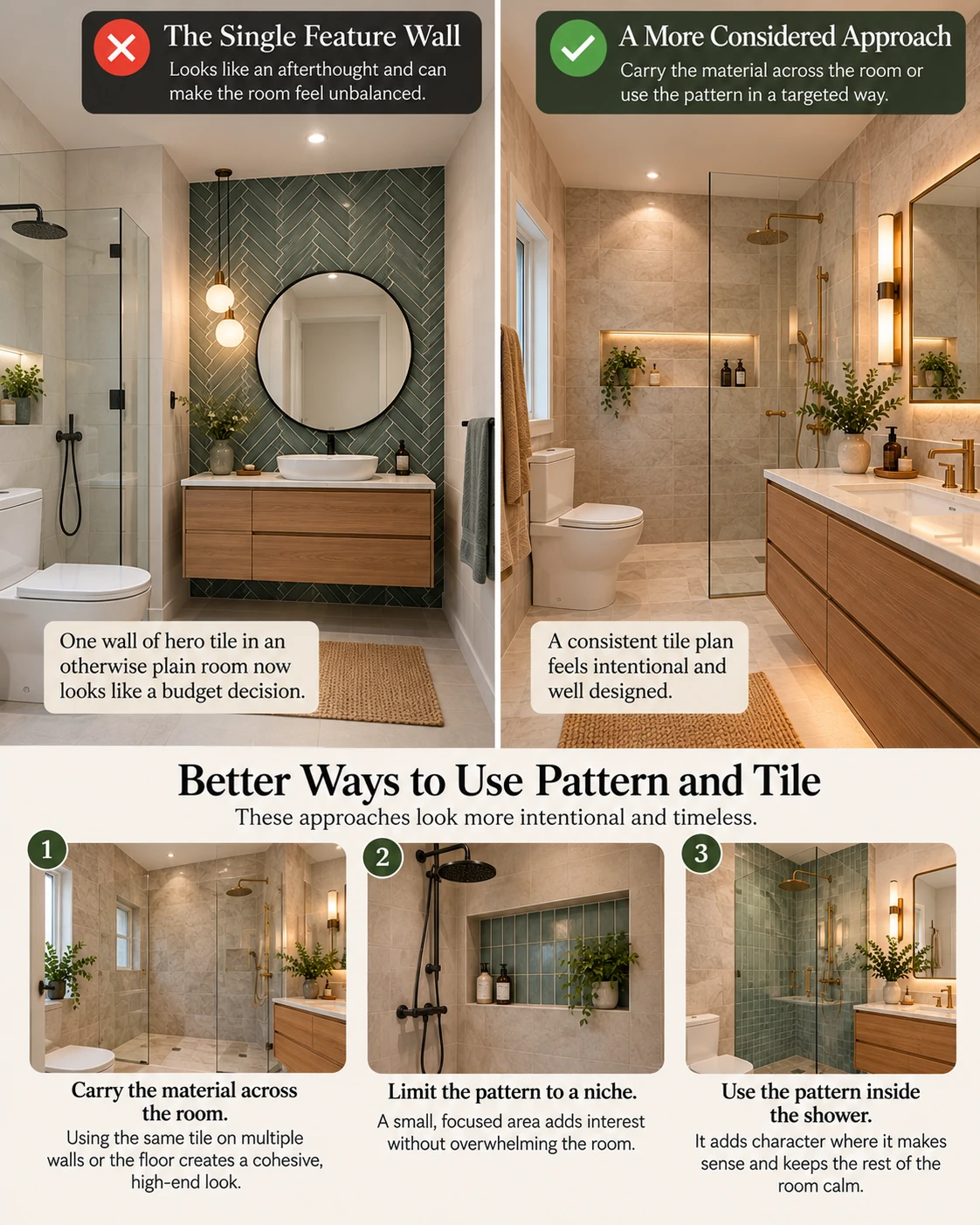
One wall of expensive “hero” tile in an otherwise plain room used to be the standard way to add interest. It now looks like an afterthought.
What to do instead: Carry the material across the room, or limit the pattern to a niche or the inside of the shower. A considered tile plan feels intentional. A lonely accent wall feels like a budget decision.
7. Overly matched sets
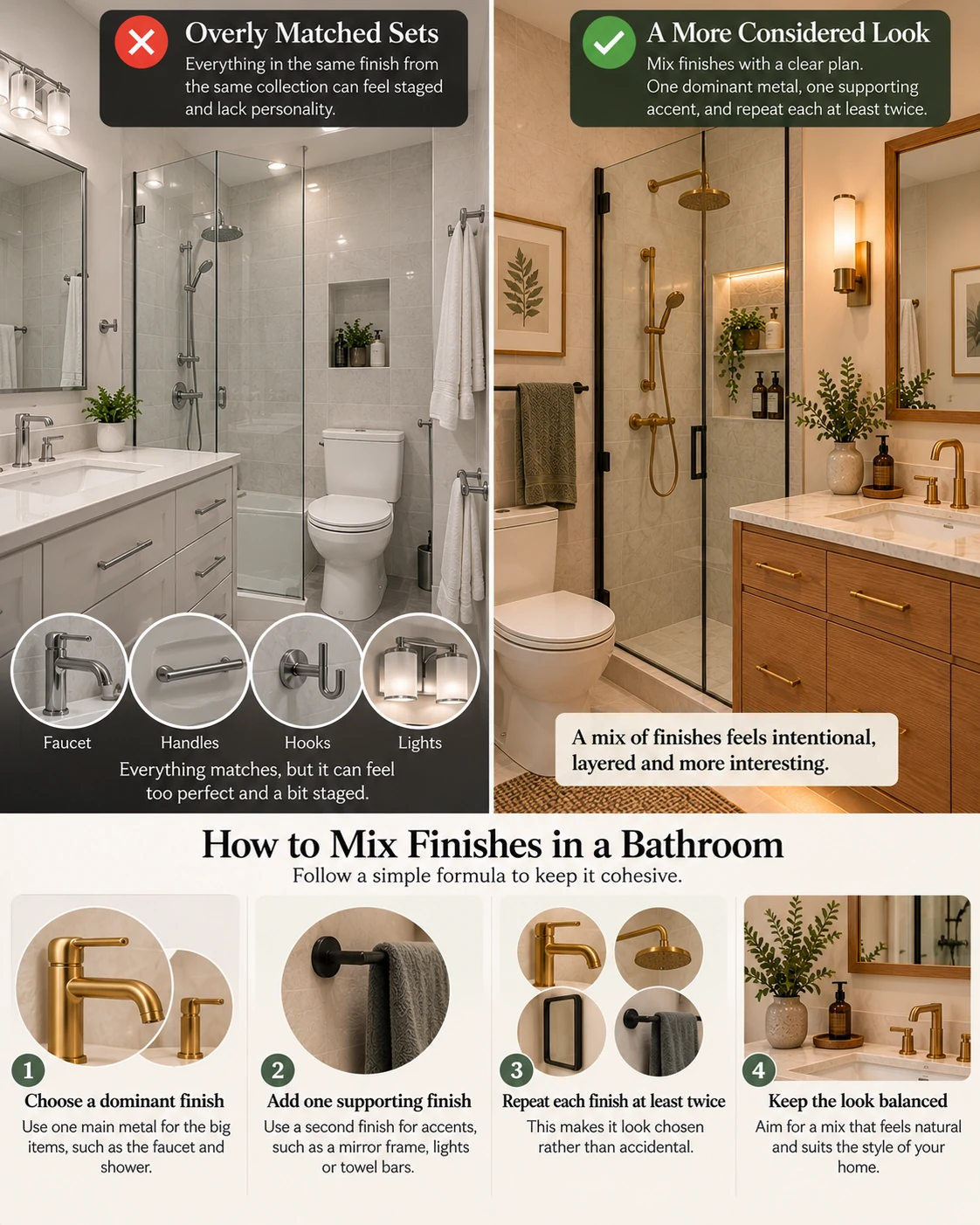
Every faucet, handle, hook, and light in exactly the same finish, from the same collection. It’s tidy, but designers say it feels staged.
What to do instead: Mix finishes on purpose, with one dominant metal and one supporting accent. The trick is repeating each finish at least twice so it looks chosen rather than accidental.
8. Icy blue and pastel palettes
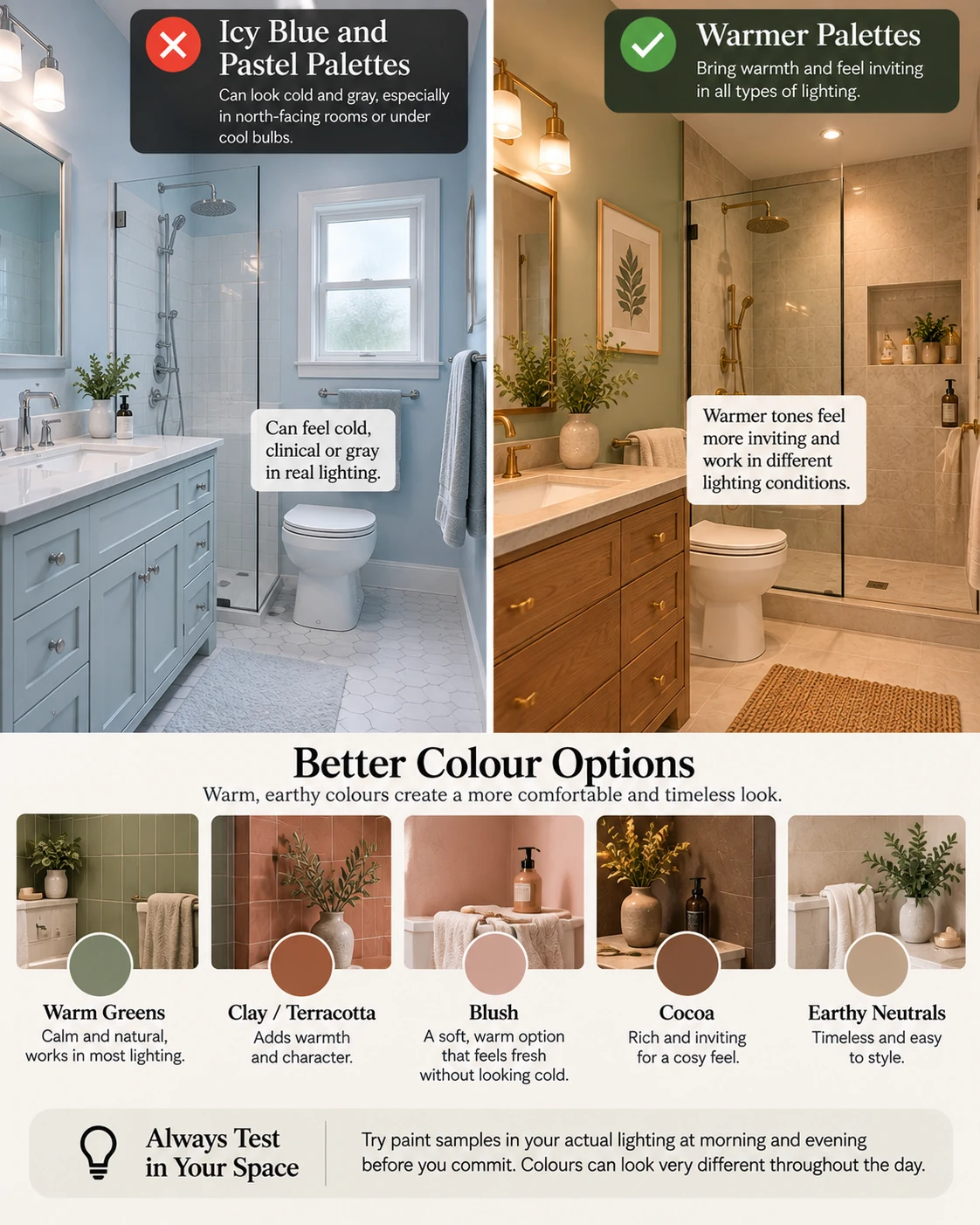
Soft pastels and pale spa blues looked fresh for a while, especially online. In person, in north-facing rooms or under cool bulbs, they can turn cold and gray.
What to do instead: Warm greens, clay, blush, cocoa, and earthy neutrals. Test paint in your actual lighting at morning and evening before you commit.
9. Heavily textured 3D tile
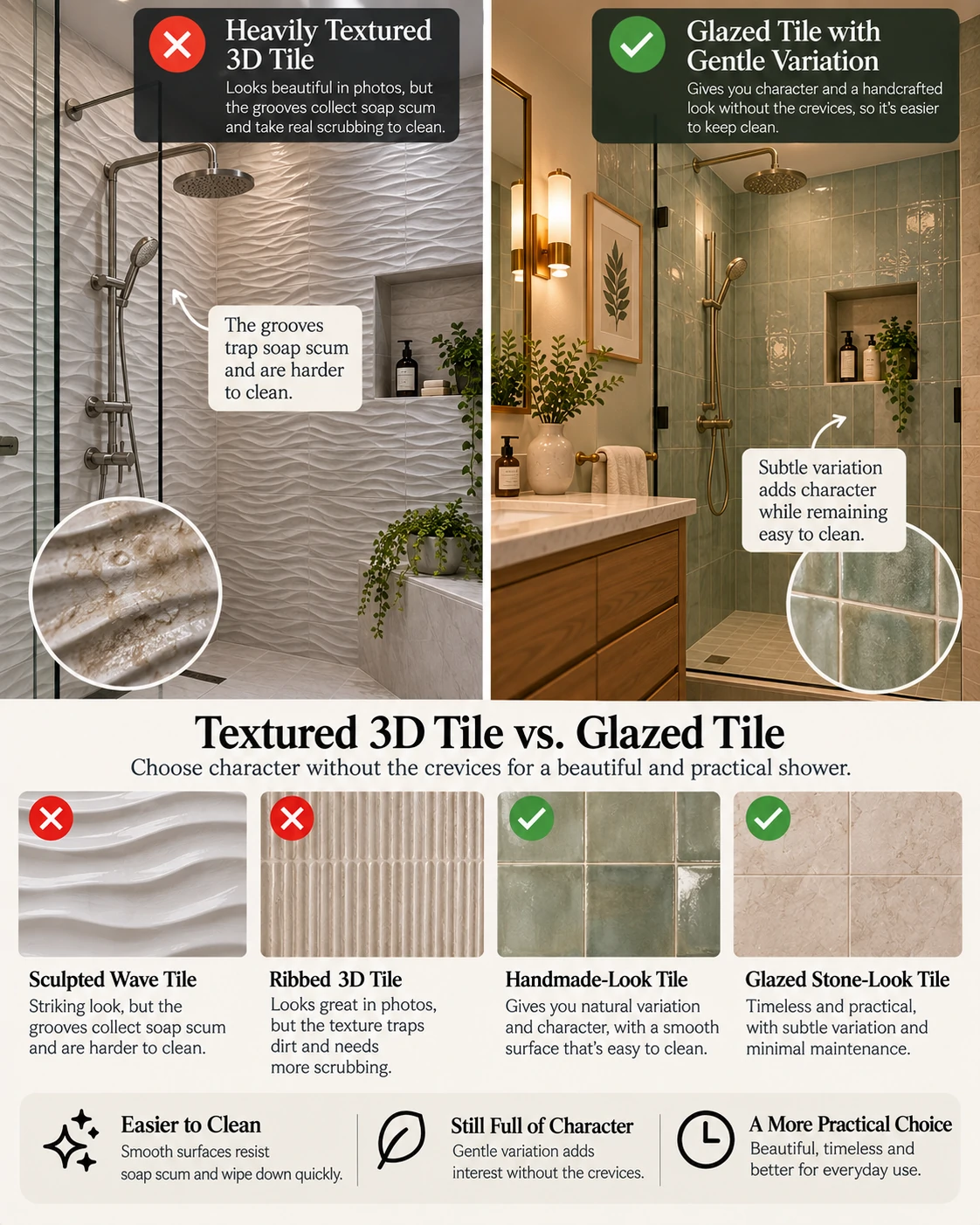
Sculpted, wavy, and ribbed wall tile looks wonderful in a photo. In a shower, the grooves collect soap scum and take real scrubbing to clean.
What to do instead: Choose a glazed tile with gentle surface variation, like a handmade-look finish, which gives you character without the crevices.
10. Overhead-only recessed lighting
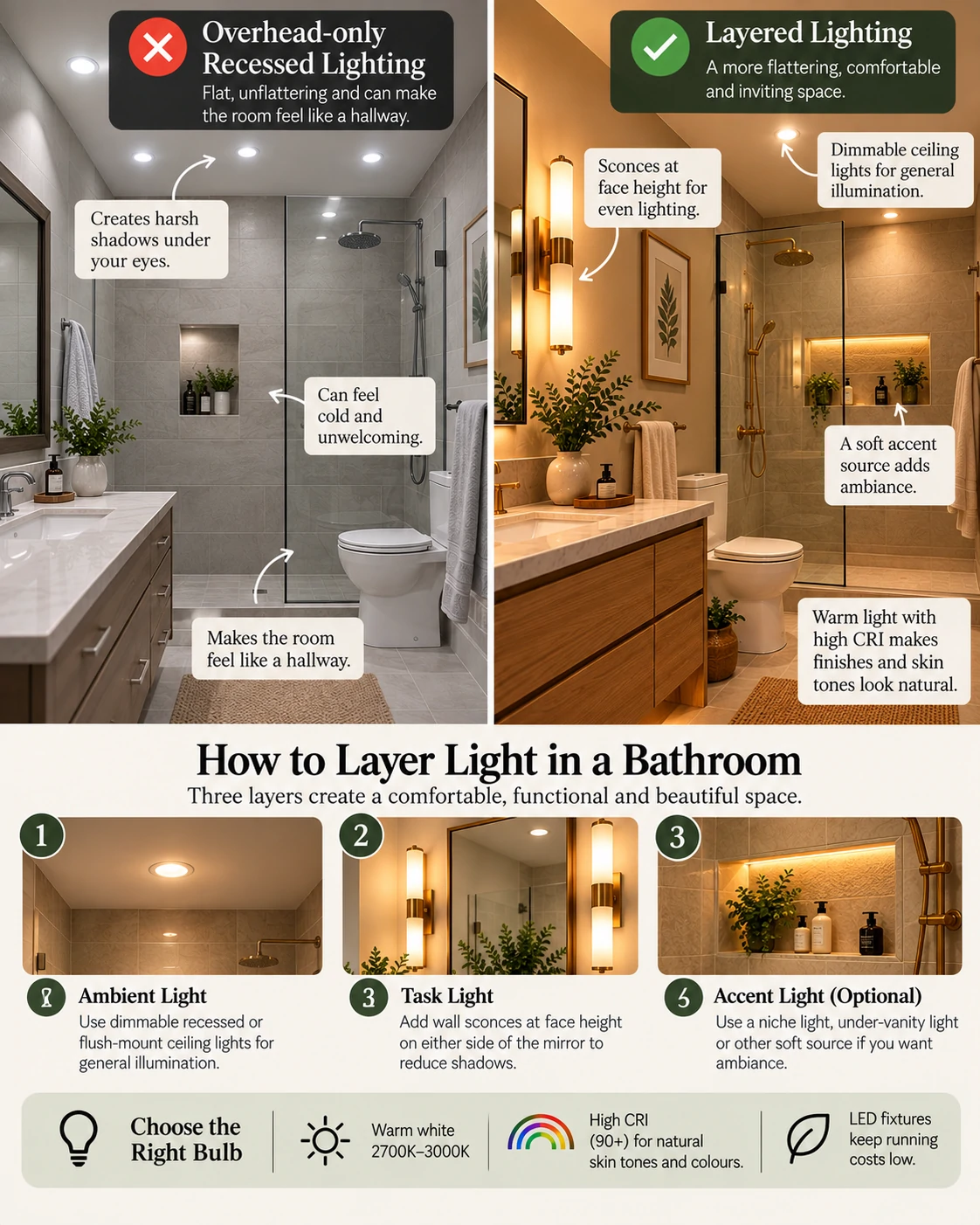
A grid of downlights is flat and unflattering. It throws shadows under your eyes and makes the room feel like a hallway.
What to do instead: Layer the light. Use dimmable ceiling lights for general light, sconces at face height beside the mirror for tasks, and a soft accent source if you want ambiance. Choose warm bulbs with a high CRI so skin tones and finishes look natural. LED fixtures also keep running costs low, which is a nice side benefit.
11. Plain flat-front vanities and showroom styling
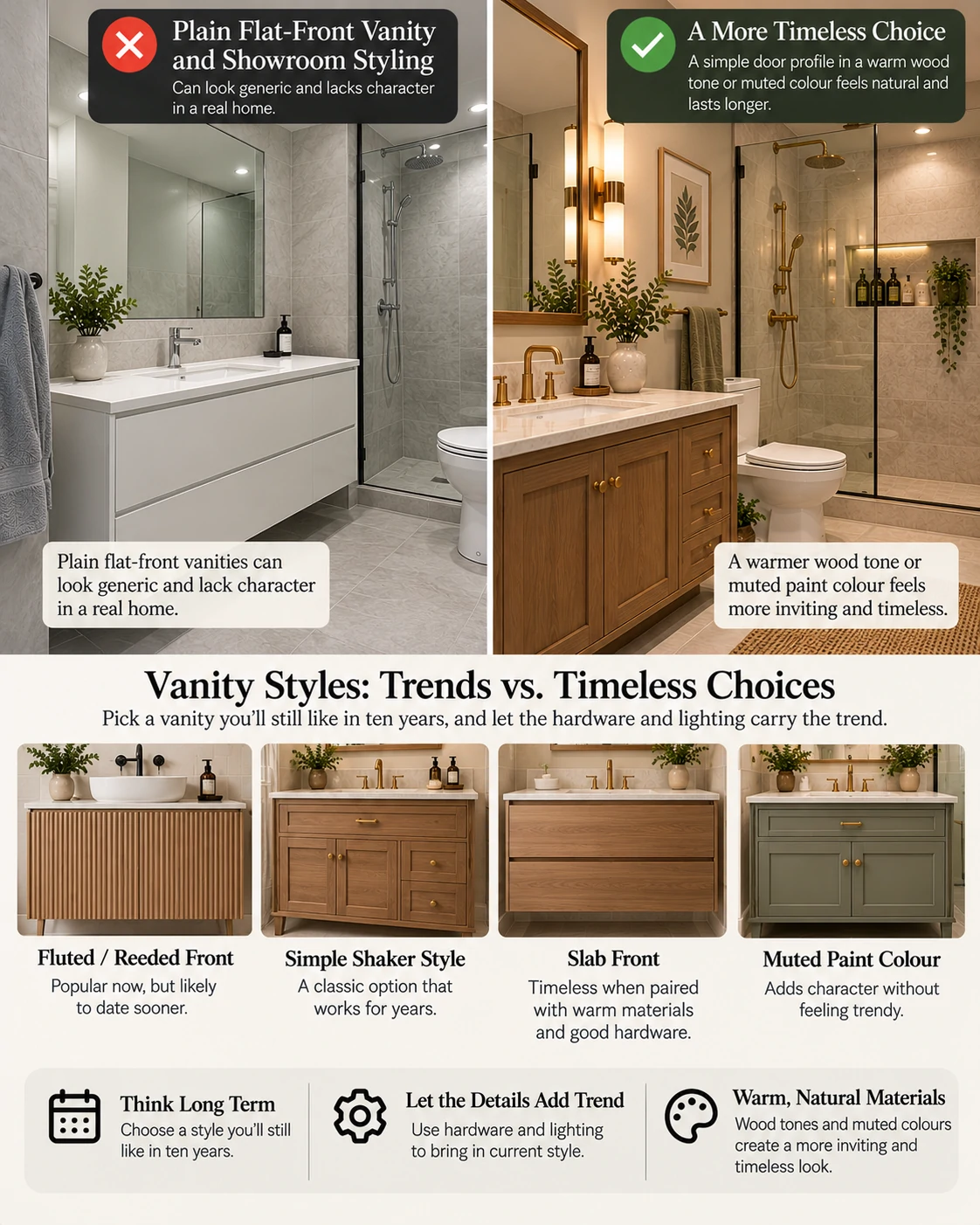
Designers are leaning toward vanities with more visual interest, like fluted or reeded fronts and warmer wood tones. There’s a catch we’ll come back to: fluted fronts are the new overused look, and they’re likely to date sooner than a simple shaker or slab door.
What to do instead: Pick a vanity you’d still like in ten years, such as a simple door profile in a warm wood tone or muted paint color, and let the hardware and lighting carry the trend.
12. Tech that replaces usability
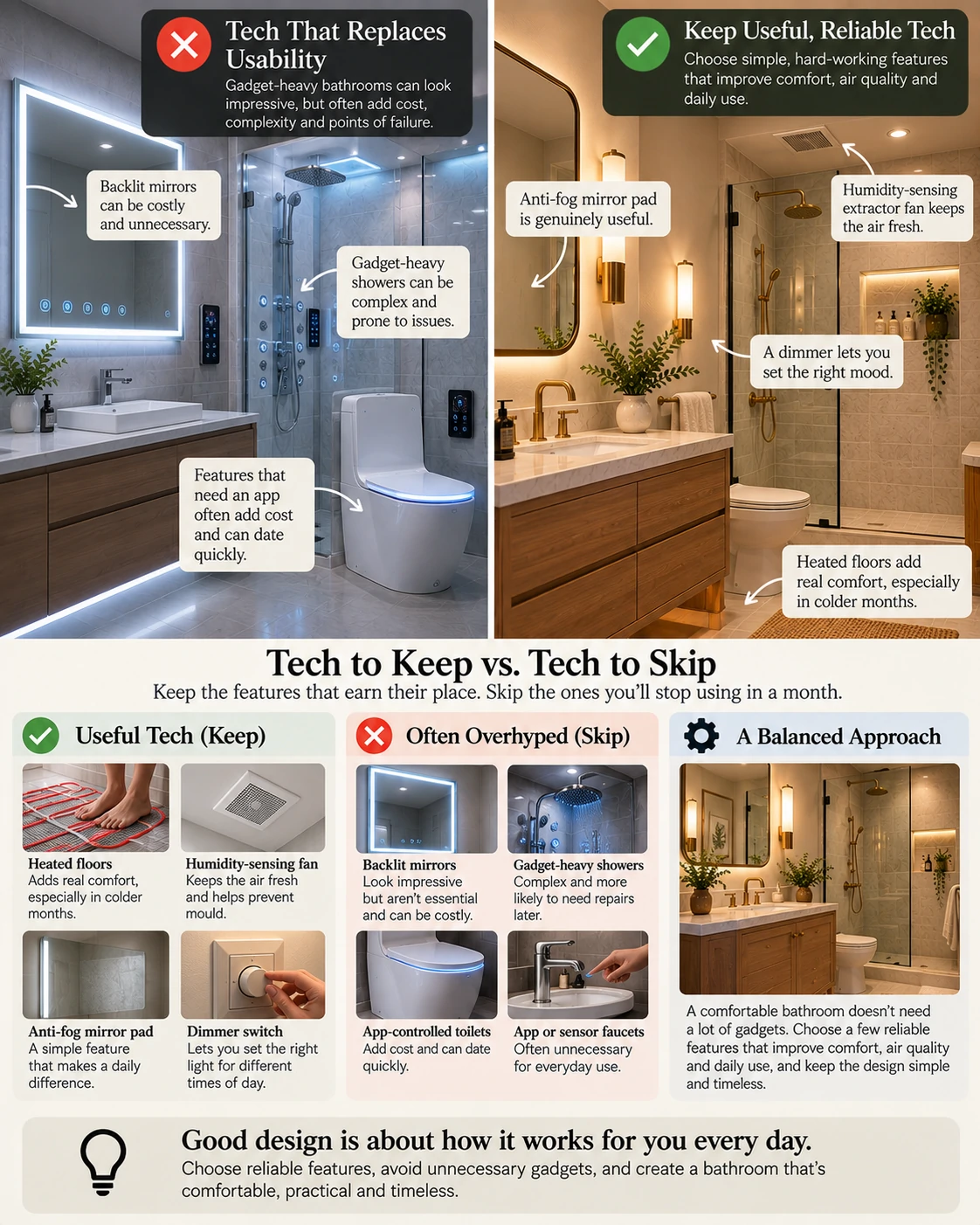
Backlit mirrors, gadget-heavy showers, and anything that needs an app to wash your hands. Designers are noting a shift toward analog, low-tech spaces. In practice, tech that adds a point of failure is a cost you pay later.
What to do instead: Keep the tech that earns its place: heated floors, a humidity-sensing extractor fan, an anti-fog mirror pad, a dimmer. Skip the features you’ll stop using in a month.
Not every “outdated” trend is a problem
This is the part most trend articles skip. Design media and the real world don’t always agree.
| Look | What designers say | What buyers and daily life say | Verdict |
|---|---|---|---|
| White tile | Cold, builder-standard | Clean, neutral, widely accepted | Keep if in good shape; warm it up with light, paint, and hardware |
| Matte black accents | Overused | Fine in small doses | Fine as an accent, risky as an everything finish in hard-water areas |
| Tub-shower combo | Being replaced by walk-in showers | Practical, space-efficient, expected in many family homes | Keep it, especially if it’s the home’s only tub |
| Cement or patterned tile | Needs a fresh take | Still beloved when used with restraint | Update the color or scale rather than abandoning pattern entirely |
| Mixed metals | Now the standard | Many buyers like it if it looks deliberate | Fine; use one dominant metal and repeat each finish twice |
If your bathroom is dated-looking but functional, you probably don’t have a tile problem. You probably have a lighting, color, and hardware problem, and those are cheap to fix.
What 2026 bathrooms look like instead (and what could date next)
The common thread across the “new” looks is warmth, texture, and durability. Think honed or tumbled stone, handmade-look tile, wood tones, soft curves, and light that makes everything look better.
Here’s how the main styles compare:
| Style | Defining features | Cost tier | Maintenance | Best room size | Resale appeal | Trend longevity |
|---|---|---|---|---|---|---|
| Cold all-white / all-gray modern (fading) | White or gray porcelain, chrome, cool light | Low to mid | Easy to clean; shows soap scum on dark grout | Any; feels coldest in large rooms | Safe, neutral | Short |
| High-contrast black & white (fading) | Black fixtures, graphic tile | Mid | High: water spots and grout stains | Medium to large | Polarizing | Short to medium |
| Warm organic modern | Warm neutrals, stone-look tile, wood vanity, soft curves | Mid to high | Moderate: stone sealing, grout upkeep | Small to large | Strong | Medium to long |
| Transitional / classic revival | Shaker vanity, mixed metals, simple pattern, framed mirror | Mid | Moderate | Small to large | Very strong | Long |
| Japandi / spa minimal | Pale wood, tonal walls, clean lines | Mid to high | Moderate: timber near water needs care | Medium to large | Good | Medium to long |
What to choose, element by element
| Element | Best choice | Common mistake | Maintenance reality |
|---|---|---|---|
| Floor tile | Matte or lightly textured porcelain with a wet-area slip rating | Polished tile that’s slippery, or deep texture that holds dirt | Low; seal grout, scrub textured surfaces |
| Wall tile | Larger format with gentle variation, carried across more than one wall | One feature wall, or strong 3D relief | Glazed is easy; heavy texture traps soap scum |
| Grout | Mid-tone warm color close to the tile; epoxy in wet areas if budget allows | Bright white on floors; stark contrast that makes pattern busy | White discolors; epoxy resists stains but is harder to install |
| Vanity | Real wood or quality veneer, or muted paint, simple door profile | Chasing fluting or a glossy white box | Wood needs sealed edges; painted doors show chips |
| Fixtures | Brushed nickel, brushed or champagne brass, or deliberate mixing | All matte black; unlacquered brass without accepting patina | Brushed hides spots; unlacquered brass changes color by design |
| Mirror | Framed or arched; add an anti-fog pad if needed | Large backlit mirror that depends on a powered part | Frameless: wipe edges; backlit: electronics can fail |
| Lighting | Layered, dimmable, 2700K–3000K, high CRI | Overhead-only; cool-white bulbs | Low; check the IP rating near water |
| Countertop | Quartz, solid surface, or sealed stone with undermount sink | Tile top; vessel sink on a thin counter | Quartz: low; stone: reseal periodically |
A small-room note: in a bathroom under about 40 square feet, scale matters more than color. Larger tile with fewer grout lines, a floating or slim vanity, and a framed mirror that reflects light will do more than any palette change. Skip bulky statement pieces.
The warning nobody puts in a trend article
The replacements will date too. Fluted vanities, microcement, terracotta, and zellige-style tile are everywhere on social media right now, which usually means they’re near the top of their popularity curve.
The safe approach is the same hierarchy we started with: keep the permanent surfaces (tile, layout, tub) simple and neutral, and put the trendy look into things you can change cheaply, like paint, mirrors, lighting, hardware, and accessories.
Real-world design mistakes to avoid in a 2026 update
Save this checklist before you shop.
- Putting matte black on every fixture because it looks sharp online. In hard-water areas it shows spots. Use black once or twice and choose a brushed finish for the faucet and shower.
- Installing a vessel sink on a standard-height counter. The rim ends up too high and water splashes out. Choose an undermount or integrated sink.
- Tiling the countertop. Grout lines stain. Use quartz, solid surface, or sealed stone.
- Doing one feature wall of expensive tile in a plain room. Carry the material through or confine it to a niche.
- Choosing heavily textured 3D tile for the shower. It traps soap scum. Pick glazed tile with gentle variation.
- Relying on overhead recessed lights only. Add sconces at face height and a dimmer.
- Using cool-white bulbs with white tile and gray grout. Switch to 2700K–3000K with high CRI.
- Matching every finish exactly. Mix deliberately, with one dominant metal.
- Choosing floor tile for looks without checking the slip rating. Smooth or polished tile is dangerous when wet. Check the standard used in your country.
- Replacing one trend with the next. Swapping gray for fluted wood and terracotta everywhere risks the same dated feeling in a few years.
How much does it cost to update a dated bathroom?
Here are typical planning ranges in USD for a roughly 5 ft × 8 ft bathroom. They’re estimates, not quotes, and labor swings widely by region and by whether plumbing or electrics move. For the UK, Canada, and Australia, convert and check local labor rates.
| Cost category | Budget ($) | Mid ($$) | Premium ($$$) |
|---|---|---|---|
| Floor tile | $150–$400 | $400–$1,000 | $1,000–$2,500 |
| Wall tile | $400–$900 | $900–$2,200 | $2,500–$6,000 |
| Vanity | $250–$600 | $700–$1,800 | $2,000–$5,000+ |
| Fixtures | $200–$500 | $600–$1,400 | $1,500–$4,000 |
| Lighting | $100–$250 | $300–$700 | $800–$2,000 |
| Mirror | $60–$200 | $200–$500 | $500–$1,500 |
| Labor (tile + install) | $3,000–$6,000 | $6,000–$11,000 | $12,000–$25,000 |
| Estimated total | ~$4,200–$8,900 | ~$9,100–$18,600 | ~$20,300–$46,000+ |
A few things worth knowing about these numbers:
- Labor is usually the biggest line. That’s why swapping finishes without moving the layout is so much cheaper than a full gut.
- Surprises tend to show up behind the tile. Rotted subfloor, old waterproofing, or outdated plumbing can add cost once the walls are open. Keep a contingency.
- Premium isn’t always better looking. Some of the best-feeling bathrooms use mid-priced materials with excellent lighting and careful layout.
The refresh-first route (roughly $500–$1,500)
Before you commit to demolition, try this. It addresses cold white, matte black overload, and a bare lighting plan without touching tile:
- Repaint in a warm neutral or soft green.
- Replace bulbs with 2700K–3000K, high-CRI LEDs and add a dimmer.
- Swap the mirror for a framed or arched one.
- Replace hardware and add towel hooks.
- Replace the vanity top or refinish the door fronts.
- Re-caulk the tub, shower, and sink joints.
For many dated bathrooms, this is the whole job.
DIY or designer? What you can safely do yourself
| Task | DIY-friendly? | Notes |
|---|---|---|
| Painting walls and ceiling | Yes | Use moisture-resistant paint and ventilate well |
| Swapping bulbs, adding a plug-in or switch-in dimmer | Usually | Turn the power off at the breaker; use a dimmer rated for your bulbs |
| Replacing mirror, towel hooks, cabinet pulls | Yes | Use proper anchors |
| Replacing a faucet | Often | Shutoff valves and compatibility can complicate it |
| Re-caulking | Yes | Remove old caulk fully and let surfaces dry |
| Replacing a vanity top | Sometimes | Plumbing connections and weight make it harder than it looks |
| Retiling a floor or shower | Not recommended for beginners | Waterproofing and flatness errors are expensive to fix |
| Moving plumbing, adding circuits, heated floors | No | Licensed trades only |
Safety callout: waterproofing, electrical work, and plumbing near water are compliance issues, not style choices. In the US and Canada, bathroom outlets and heated-floor systems need GFCI protection. In the UK and Australia, bathroom zones and IP ratings apply to lights and fittings. Hire a licensed electrician for anything beyond a like-for-like swap.
When a designer is worth it: if you’re changing layout, mixing several materials, or you keep second-guessing your palette. A few hours of design help costs far less than redoing tile.
Maintenance reality of the 2026 look
The warm, textured look is lovely, but it asks for different habits than gloss white tile.
| Task | Frequency | Difficulty | Notes |
|---|---|---|---|
| Wipe fixtures and glass after showers | Daily to weekly | Easy | A squeegee cuts water spots on black and brass |
| Clean shower tile and grout | Weekly | Easy to moderate | Soft brush on textured tile; avoid harsh acids on stone |
| Seal natural stone and cementitious grout | Every 1–2 years (follow the manufacturer) | Moderate | Skip it and stone stains and etches faster |
| Check and re-caulk joints | Every 1–3 years | Moderate | Failed caulk is a common leak starting point |
| Clean extractor fan and check airflow | Every 6–12 months | Easy | Poor ventilation hurts paint, wood, and grout in any style |
| Care for wood or veneer vanity | Monthly wipe; check edges yearly | Easy | Seal edges and wipe up standing water |
| Polish or accept patina on brass | As you like | Easy | Unlacquered brass changes color by design |
| Test heated-floor thermostat and GFCI/RCD | Yearly | Moderate | Call an electrician if the test button fails |
Expert warnings
⚠️ Don’t replace one trend with the next. Many 2026 alternatives are already everywhere online. Put permanent decisions in calm, simple materials and add the trend through swappable items.⚠️ Waterproofing and slip resistance aren’t style choices. Textured or matte tile can be slippery or hard to clean depending on the product, and every tile project depends on properly installed waterproofing. Check the slip-rating standard in your country (DCOF in the US, pendulum test value in the UK, R or wet barefoot ratings in Australia) and use licensed trades for wet-area waterproofing and electrical work near water.⚠️ “Outdated” is not the same as “worth replacing.” Spending thousands to remove a perfectly functional white-tile bathroom because a magazine called it dated is rarely good value. Warm it up first, then decide.
Resale and longevity: does following (or ignoring) trends matter?
It depends on how long you’ll stay.
- Selling in 1–2 years: keep tile and layout neutral, fix obvious wear, and refresh lighting, hardware, and paint. Skip bold trend swaps. Buyers respond to clean, bright, and well-maintained far more than to a particular tile.
- Staying 8+ years: choose finishes you enjoy using, but keep permanent surfaces simple and let trends live in swappable items.
- Investing or renting out: durable, easy-clean materials beat fashionable ones. A tile countertop or vessel sink is a maintenance call waiting to happen.
Be careful with advice that tells you to remove a tub. In many family markets, buyers expect at least one bathtub in the house. If yours is the only one, a walk-in shower conversion can narrow your buyer pool.
Regional notes: US, UK, Canada, and Australia
- United States: tub-shower combos are still common and often expected. Wet-tile slip guidance usually references DCOF. GFCI protection applies to bathroom outlets and heated floors.
- United Kingdom: bathroom zones and IP ratings decide which lights and fittings you can use. Heated towel rails are common, and wet rooms are increasingly popular but depend on correct tanking.
- Canada: cold winters make heated floors a practical comfort feature, not just a luxury. Ventilation matters because of humidity in closed-up houses.
- Australia: waterproofing standards are strict and licensed work is typically required in wet areas. Slip ratings use R and wet barefoot classifications. Climate varies, so mold control and ventilation are the bigger design drivers in humid regions.
In every market, check local building rules before you plan electrical or wet-area changes.
Does this update make sense for you?
Use this quick check:
- White and gray but in good condition? Warm it up with paint, bulbs, mirror, and hardware. Replace tile only if it’s damaged.
- Selling within 1–2 years? Keep tile and layout neutral and refresh the visible, cheap items.
- Staying 8+ years? Choose what you’ll enjoy, keep the permanent layer simple.
- Hard-water area? Avoid matte black on high-touch fixtures. Choose brushed nickel, PVD brass, or chrome.
- Under 40 sq ft? Use larger tile, a floating or slim vanity, reflective surfaces, and layered lighting.
- Young kids or shared use? Skip vessel sinks and slippery floor tile.
- Have a vessel sink or tile countertop now? Replace the countertop and sink before touching wall tile.
- Changing plumbing, electrics, waterproofing, or heated floors? Hire licensed professionals.
Frequently asked questions
What bathroom trends are outdated in 2026?
The looks designers are moving away from include all-white and all-gray schemes, icy blue palettes, matte black fixtures used everywhere, vessel sinks, tile countertops, wood-look tile in showers, single feature walls, heavily textured 3D tile, and overly matched fixture sets. The common thread is cold, staged, or hard-to-maintain design. Warmer colors, natural textures, mixed finishes, and better lighting are replacing them. Not every item needs replacing, especially if it’s in good condition.
Is matte black still okay in a bathroom in 2026?
Matte black isn’t banned, but many designers see it as overused, and it can be harder to live with than expected. It tends to show water spots and soap residue, especially in hard-water areas, and some finishes show wear on frequently touched parts. If you like it, use it sparingly, such as a mirror frame or one accessory, or choose a high-quality brushed finish. For the main faucet and shower, brushed nickel or brass is more forgiving.
Are white bathrooms outdated?
White itself isn’t the issue. Cold, all-white and all-gray rooms with cool lighting and no texture are what read as dated. A white bathroom in good condition can often be warmed up with paint, warmer bulbs, a wood or stone element, and brushed brass or nickel hardware. White tile remains a safe, neutral choice for resale. Replacing it purely because of trends is rarely good value.
Why are vessel sinks going out of style?
Vessel sinks sit on top of the counter, so water splashes onto the surface, the rim can be too high for children and shorter users, and the base is awkward to clean. The tall faucet they require also tends to feel less comfortable in daily use. Designers now prefer undermount or integrated sinks for easier cleaning and a simpler look. If you already have one and like it, that’s fine; just keep the counter and faucet height practical.
Will the new 2026 bathroom trends look dated in a few years too?
Some might. Fluted vanities, microcement, terracotta, and zellige-style tile are everywhere right now, which usually means they’re near the top of their popularity. The safest approach is to keep permanent surfaces, like tile, layout, and tub, simple and neutral, and add trend-driven elements through items you can change cheaply, like paint, mirrors, lighting, hardware, and accessories.
The practical takeaway
If your bathroom works, is clean, and just feels a little cold, you probably don’t need a renovation. You need warmer light, a better mirror, finishes that suit how you live, and one or two swaps that take the room out of 2019.
If you are renovating, put your effort where it’s hardest to reverse: layout, waterproofing, and tile. Keep those calm and durable, and let the trends play out in paint, lighting, and hardware.
For more on choosing styles that last, see our guide to bathroom design ideas, and when you’re ready to plan budgets and timelines, our bathroom renovation guide walks through the whole process.
.webp)
.webp)
 (1).webp)
.webp)
.webp)