.webp)
Walk into a hotel bathroom you remember fondly. Chances are it wasn’t the size or the gold taps that stuck with you. It was the warm light, the shower that held its temperature, the lack of visual clutter, and the fact that nothing looked like it was about to fail.
That’s the real brief behind most luxury bathroom design ideas. People search for them wanting pictures. What they usually need is a way to decide what’s worth paying for.
What Makes a Bathroom Feel Luxurious? (Quick Answer)
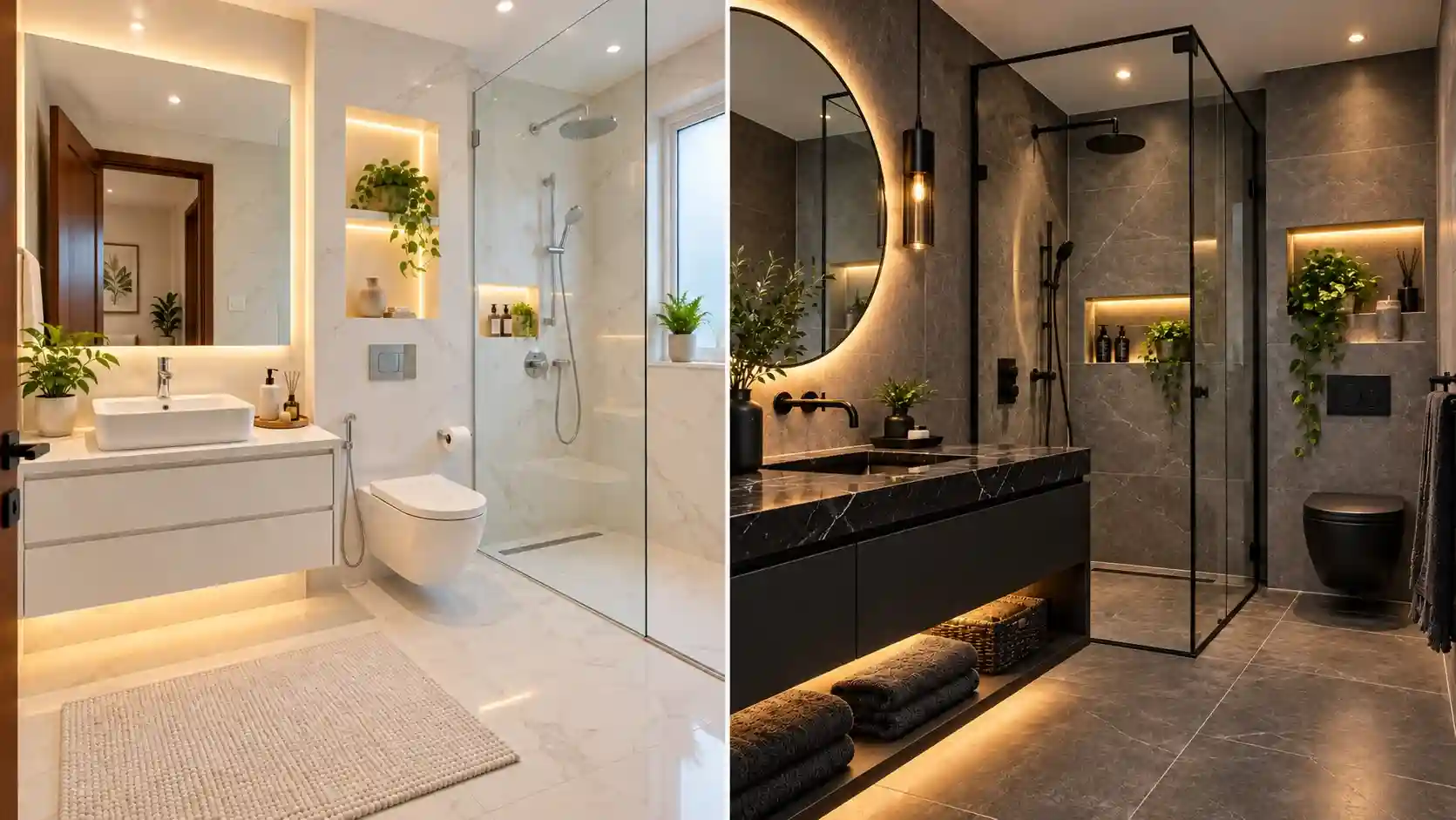
Short answer: A luxury bathroom is defined by quality materials, layered lighting, calm uncluttered space, and precise detailing, like large-format stone-look tile, frameless glass, a thermostatic shower, heated floors, and a generous vanity, not by price or size alone.
A slightly fuller version: a luxury bathroom combines durable materials (stone or stone-look porcelain, quartz or solid-surface tops, quality brassware) with layered lighting, real storage, and comfort features like underfloor heating and a thermostatic shower. What separates it from merely expensive is execution: tight grout lines, flush tile edges, proper ventilation, and a restrained palette that stays cohesive.
Quick takeaways
- Luxury is execution plus restraint: fewer materials, better installed.
- Layered lighting (ambient, task, accent) does more for a high-end feel than any single fixture.
- Large-format tile with narrow, tone-matched grout reads as premium and is easier to keep clean.
- The comfort features owners keep appreciating are quiet ones: heated floor, thermostatic valve, silent extractor fan.
- Budget the labor and waterproofing, not just the tile. They often cost more than the materials.
- Choose a neutral core with personal accents to protect resale and avoid trend regret.
Regional terms at a glance (US / UK / CA / AU)
- Vanity (US/CA) = vanity unit (UK) = vanity (AU)
- Countertop (US/CA) = worktop (UK)
- Exhaust fan (US/CA) = extractor fan (UK/AU)
- Waterproofing membrane (US/CA) = tanking (UK/AU)
- Towel warmer (US) = heated towel rail (UK/CA/AU)
- GFCI (US/CA) = RCD (UK/AU)Electrical and plumbing rules differ by country, state and municipality. Verify local code before you buy or build anything.
.webp "Luxury Bathroom Design 01")
Luxury Is a Set of Decisions, Not a Price Tag
Here’s something that surprises people: a $9,000 bathroom can feel more luxurious than a $45,000 one. It happens often. The expensive room has six tile types, three metal finishes, a statement pendant, and a vanity that fights the layout. The cheaper one has one calm material, good light, and a clean install.
Luxury comes from five decisions, each of which you can make at nearly any budget.
- Materials. Few, durable, and consistent. Stone or convincing stone-look porcelain, quartz, solid surface, real wood veneer with proper moisture protection.
- Light. Layered, warm, dimmable. This changes how everything else looks.
- Space and calm. Clear surfaces, fewer visual breaks, concealed storage, generous clearances.
- Quiet technology. A thermostatic shower valve, heated floor, silent fan, humidity-sensing controls. Features that work without asking for attention.
- Detailing. Even grout, aligned tile joints, flush edges, consistent hardware. This is the one most people underinvest in.
If you only remember one thing, remember this: restraint is what reads as expensive. Every extra material or finish needs a reason to be there.
.webp "Lighting Design Ideas 02")
Luxury Bathroom Styles Compared
Before choosing finishes, choose a direction. Styles differ less in how they look than in how they age, how much work they demand, and how widely they appeal when you sell.
Each of these can look high-end. The real question is which set of trade-offs suits your home and the way you live.
| Style | Defining Features | Cost Tier | Maintenance | Best Room Size | Resale Appeal | Trend Longevity |
|---|---|---|---|---|---|---|
| Contemporary Spa | Large-format stone-look porcelain, floating vanity, frameless glass, layered warm lighting, minimal grout, restrained neutral palette | Mid–High | Low–Medium | Any; excellent in small rooms | High (broad appeal) | High (proportion-led, not fad-led) |
| Classic / Transitional Luxury | Honed or marble-look tile, furniture-style vanity, polished nickel or chrome, framed mirrors, brass accents, wainscot or panelling | Mid–High | Medium (higher with real marble) | Medium to large | High | High |
| Japandi | Light oak or ash, warm off-whites, textured plaster or microcement, low-profile tub, concealed storage, deliberate negative space | Mid–High | Medium (wood needs sealing and ventilation) | Small to medium | Medium–High | High |
| Art Deco / Glam | Geometric or fan tile, brass or gold finishes, dark stone, fluted glass, statement lighting | High | Medium–High (finishes show marks) | Medium to large | Medium (polarising) | Medium |
| Organic Modern | Honed stone, plaster-look walls, wood vanity, matte or brushed metals, plants, earth tones, soft-edged shapes | Mid–High | Medium | Medium to large | High | Medium–High |
A note on Japandi, since it’s frequently misread: it isn’t “wood plus beige.” It depends on negative space, concealed storage, and a short palette. Open shelving packed with product bottles breaks it instantly.
.webp "Luxury Bathroom Design 03")
The Design Elements That Do the Heavy Lifting
Each subsection below ends with a year-5 reality note: what the choice tends to look like after daily use, hard water, and a few hundred rounds of cleaning products.
Tile, Grout and Layout
Tile gets all the attention, but grout changes the look more than tile colour does. High-contrast grout turns a surface into a grid and highlights every small misalignment. Tone-matched, narrow grout (roughly 1.5–3 mm on rectified tile) creates the continuous surface that reads as premium.
Scale matters too. In smaller rooms, fewer and larger tiles (600×1200 mm / 24×48 in is a common format) mean fewer lines and a calmer space. Running tile floor-to-ceiling in the wet zones looks deliberate. Stopping at an arbitrary mid-height rarely does.
One thing most homeowners don’t realize until the tile arrives: large-format tile is less forgiving. It exposes uneven substrates, and lippage (where adjacent tile edges sit at slightly different heights) shows up fast under side lighting. This is where installer skill matters more than tile price.
Year-5 reality: Porcelain barely changes. Cement grout can stain and needs sealing and periodic checks. Epoxy grout costs more up front, but resists staining better, especially in showers.
.webp "Luxury Bathroom Design 04")
Lighting: The Layer Most People Get Wrong
Lighting is where average bathrooms and high-end bathrooms separate most clearly. A single bright ceiling light is flat and shadowy. A well-planned scheme has three layers:
- Ambient: recessed or ceiling fittings, dimmable.
- Task: eye-level light beside or around the mirror, for shaving, makeup, and skin checks.
- Accent: a niche strip, toe-kick glow, or cove light that adds depth and works as a night light.
Specs matter more than shape. Aim for 2700–3000K colour temperature and CRI 90+ so stone, wood, and skin tones look natural. Cool 4000–5000K “daylight” LEDs tend to make stone look grey and skin look tired.
And one common trap: a backlit mirror is not task lighting. Halo lighting looks beautiful in photos, but it often leaves the face under-lit from the front. Add side or eye-level sconces if you groom at the mirror.
Fittings must also be rated for their zone: damp or wet-location listed in the US and Canada, IP-rated in the UK and Australia.
A small automation upgrade worth considering: motion-sensor night lighting at a low, warm level. It saves you from blasting your eyes at 3 a.m., and it quietly adds to the hotel-bathroom feel.
Year-5 reality: LEDs are low-maintenance, but cheap drivers and mirror seals are the usual failure points. Moisture getting behind a mirror’s edge shortens its life.
.webp "Luxury Bathroom Design 05")
Fixtures and Finishes (Including the Hard-Water Problem)
Finishes are a durability decision disguised as a style decision.
| Finish | Looks | Hard-water behaviour | Wear |
|---|---|---|---|
| Polished chrome | Bright, classic | Hides spotting reasonably well; wipes clean | Very durable |
| Brushed nickel | Soft, warm-grey | Forgiving; hides spotting and fingerprints | Durable |
| PVD brushed brass | Warm, premium | Fairly forgiving | PVD generally outlasts plating |
| Matte black | Dramatic, graphic | Limescale and spots show clearly | Quality varies widely; cheap coatings can wear or flake |
If you love matte black, it can work. Choose a quality PVD or powder-coated finish and treat hard water with a softener or filtration. Pick one metal family for the room and stay disciplined. Mixing three finishes looks like indecision, not richness.
Year-5 reality: In hard-water areas, aerators and showerheads clog with scale. A quick descale every one to three months keeps flow and appearance consistent.
.webp "Luxury Bathroom Design 06")
Vanity, Storage and Countertops
Floating vanities look lighter and make floors easier to clean. They also have a classic failure mode: owners lose storage, clutter takes over the counter, and the clean look disappears within a month. Before committing, check drawer depth and plan concealed storage for the things you actually use daily.
For tops, quartz, sintered stone, and solid surface handle toothpaste, makeup, and cleaners without drama. Honed marble is beautiful but etches and stains if you let spills sit. If you love it, accept the patina. If you don’t, stone-look porcelain or sintered stone gets you most of the way there.
Year-5 reality: Wood veneer needs moisture control, so ventilation matters here too. High-gloss dark lacquer shows every fingerprint and toothpaste speck.
.webp "Luxury Bathroom Design 07")
Mirrors
A large frameless or slim-framed mirror reflects light and enlarges the room. Arched or curved shapes are popular right now, and they photograph well, but shape is the easiest element to swap later, so it’s a safe place to experiment.
Anti-fog mirrors are one of the more practical smart-bathroom upgrades, particularly in bathrooms shared by several people. Some include dimming or colour-temperature controls. Keep the sconce guidance above in mind regardless.
Year-5 reality: Check the edge seal and the LED driver annually. Moisture ingress is the main enemy.
.webp "Luxury Bathroom Design 08")
The Shower and Tub Experience
A thermostatic shower valve is the single most appreciated “quiet” upgrade. It holds a steady temperature when someone flushes a toilet or runs a tap elsewhere in the house. It’s a comfort and a safety feature.
Now the part that rarely makes it into inspiration galleries: rain showers and body jets are limited by your supply. Low-pressure or gravity-fed systems (common in some UK homes), regional flow-rate rules (US WaterSense labelling, Australian WELS ratings), and hot water capacity all decide whether a spa shower delivers or merely drizzles. Don’t buy a large rainfall head and hope for the best. If pressure is low, plan a pump or choose a head designed for it.
Digital shower controllers (programmable temperature and presets) are a nice touch, but they add electronics to a wet environment, so they need correct installation and rating.
Freestanding tubs look dramatic and demand homework:
- Floor load: A typical tub holds roughly 50–80 gallons (190–300 litres). Water weighs about 8.3 lb per gallon, so add the tub and a bather and the load is substantial. Check joist capacity.
- Hot water: A big tub can exceed a small cylinder or tank.
- Usage: Be honest about whether you’ll actually take baths.
- Cleaning: The space around a freestanding tub is awkward to wipe.
Year-5 reality: Glass shows limescale quickly. A squeegee habit or a hydrophobic coating changes your cleaning life. Freestanding tubs that don’t get used become expensive towel racks.
.webp "Luxury Bathroom Design 09")
Comfort Technology (Heated Floors, Smart Features, Ventilation)
Heated floors are the feature owners most often say they’d choose again. Electric mat systems are common in retrofits; hydronic systems suit larger projects or new builds. Pair them with a programmable or smart thermostat with a floor sensor and a schedule. Heating the floor on a timer rather than all day keeps running costs reasonable, and insulation underneath makes the heat go up rather than down.
Ventilation is the most underrated luxury feature. A quiet, correctly sized fan (rated in CFM or l/s) protects stone, grout, paint, and cabinetry. Condensation destroys high-end finishes faster than daily use does. A humidity-sensing fan with a run-on timer is a small upgrade with a big payoff, because it keeps working after you’ve left the room and forgotten about it.
Other smart-home-adjacent upgrades, such as heated toilet seats, bidet or washlet seats, and smart mirrors, are comfort items. They’re worth it if you’ll use them, and they need GFCI/RCD-protected outlets planned during rough-in, not after.
Year-5 reality: Fan grilles clog and fans lose airflow. Most owners never check. Heated floor controllers need an annual glance, and inconsistent temperatures are a call-a-pro situation.
.webp "Luxury Bathroom Design 10")
Design Element Decision Table (Contemporary Spa Style)
| Design Element | Best Choice | Why | Common Mistake | Maintenance Reality |
|---|---|---|---|---|
| Flooring tile | Large-format porcelain (600×1200 mm / 24×48 in) in honed or textured stone-look finish, with a wet-area slip rating | Fewer grout lines, calm continuity, hard-wearing | Polished porcelain on a bathroom floor | Textured finishes hold soap film; clean regularly with a pH-neutral cleaner |
| Wall tile | Floor-to-ceiling large-format in wet zones; one restrained accent wall or niche | Premium look, fewer joints to clean | Stopping tile at mid-height; mixing 3+ tile types | Easy wipe-down; failure usually comes from poor waterproofing, not the tile |
| Grout color | Tone-matched, 1.5–3 mm on rectified tile; epoxy in the shower if budget allows | Continuous surface, less visible staining | White grout on a floor; high-contrast grout on dark tile | Epoxy resists staining; cement grout needs sealing and re-checking |
| Vanity finish | Floating or furniture-style vanity in wood veneer or matte lacquer, soft-close, deep drawers | Visual lightness, easy to clean under, warm texture | High-gloss dark lacquer; losing all storage to a floating design | Wood veneer needs moisture control; gloss shows fingerprints and toothpaste |
| Faucet / fixture finish | Brushed nickel, polished chrome, or PVD brushed brass; matte black only in soft-water areas | Hides spotting and wear better | Matte black in hard water; mixing 3+ metal finishes | Descale regularly in hard-water areas; PVD usually outlasts plating |
| Mirror type | Large frameless or slim-framed mirror with separate eye-level lighting; optional anti-fog | Reflects light and enlarges space | A backlit mirror as the only lighting | Wipe monthly; check LED driver and edge seal |
| Lighting | Layered: dimmable ambient, side or eye-level task, accent (niche, toe-kick); 2700–3000K, CRI 90+, IP / wet-location rated | Flattering light, accurate tone and skin colour | Cool daylight LEDs; a single central ceiling light | LED fittings are low-maintenance; keep them dimmable and zone-rated |
| Countertop material | Quartz, sintered stone, or solid-surface; honed marble only if you accept etching | Stain and scratch resistance | Unsealed natural stone beside toothpaste, makeup, and cleaners | Quartz and sintered stone are low-maintenance; marble needs sealing and quick spill wipe-ups |
.webp "Luxury Bathroom Design 11")
What Photographs Well vs What Lives Well
Inspiration images are shot with styled products, perfect lighting, and an empty counter. Real bathrooms have a toothbrush holder, a bath mat, and a bottle of something blue.
| Photographs well | Lives well |
|---|---|
| Backlit mirror as the hero light | Eye-level sconces plus a dimmable ceiling layer |
| Polished marble or glossy porcelain floors | Honed or textured tile with a wet-area slip rating |
| Matte black fixtures everywhere | Brushed nickel, chrome, or PVD finishes |
| Open shelving with a few styled items | Concealed storage with deep drawers |
| Freestanding tub as centrepiece | A great shower, with a tub only if you’ll use it |
| High-contrast patterned tile | Tone-on-tone large-format with one restrained accent |
| Cool, bright “clean” white light | Warm 2700–3000K, CRI 90+, dimmable |
Neither column is “wrong.” But many regrets come from choosing the left column for a bathroom that has to survive the right.
One practical rule: test samples in the actual room, in the morning, in the evening, and under your artificial lighting. Showroom light and screens shift colour badly. Stone-look tile that looks warm in the shop can read cold and grey under your own lighting.
.webp "Luxury Bathroom Design 12")
Making Luxury Work in Small and Large Bathrooms
Luxury isn’t reserved for big rooms. Small bathrooms often benefit most from restraint, because there isn’t space to hide mistakes.
| Room size | What works | What to avoid |
|---|---|---|
| Small (under ~40 sq ft / 3.7 m²) | Large-format tile with minimal grout, frameless glass or a fixed panel, wall-hung toilet and vanity to show more floor, a single palette, one tactile upgrade (heated floor or a quality shower system) | Busy patterns, bulky vanities, mixing multiple tile types, deep-framed shower screens that chop the room up |
| Medium (~40–80 sq ft) | A defined feature zone (vanity wall or niche), layered lighting, furniture-style vanity, a walk-in shower or a tub-and-shower combo done well | Tub and oversized shower competing for the same space; too many accent features |
| Large (80+ sq ft / 7.4 m²+) | Double vanity, separate zones for bathing and showering, freestanding tub (with floor checks), more warm accent lighting | Treating the extra space as a place to add more materials; vast bare surfaces without lighting layers |
In a small room, you’re really spending your budget on continuity. In a large one, the risk is the opposite: filling space with features and losing coherence.
.webp "Luxury Bathroom Design 13")
Luxury Bathroom Mistakes People Regret
If you save one checklist from this article, make it this one.
- Polished tile on the floor. Slippery when wet. Choose a wet-area-rated honed or textured finish.
- Backlit mirror as the only light source. Shadows on the face and poor grooming light. Add eye-level side lighting.
- Cool-white LEDs (4000–5000K). They make stone and skin look harsh. Use 2700–3000K, CRI 90+, dimmable.
- Matte black fixtures in hard-water areas. Spotting shows constantly. Choose brushed nickel, chrome, or a PVD finish.
- Too many materials. Stone, wood, glass, three tiles, and two metals read as busy, not rich. Limit to 3–4 materials and one metal family.
- Unsealed marble or travertine near toothpaste, makeup, and cleaners. Etching and staining follow. Seal it, or use stone-look porcelain.
- High-contrast grout lines. They turn large tile into a grid and highlight every misalignment. Match grout to tile.
- Floating vanity with no storage plan. Looks great, then clutter takes over. Check drawer depth and plan concealed storage.
- Skipping ventilation upgrades. Condensation damages finishes. Install a properly sized, quiet fan, ideally humidity-sensing.
- Choosing finishes from a screen or showroom only. Colour shifts under real light. Test samples at home at different times of day.
.webp "Luxury Bathroom Design 14")
What a Luxury Look Really Costs
Cost is the question underneath most searches, and the honest answer is: it depends on scope, and labor is usually the largest line.
Assumptions: roughly 60 sq ft (5.5 m²) bathroom, about 150 sq ft of wall tile, standard layout with no plumbing relocation, USD, 2026 planning estimates. Local quotes will vary. UK, Canadian, and Australian labor and material costs differ, so treat this as a guide to proportions, not a quote.
| Cost Category | Budget Tier ($) | Mid Tier ($$) | Premium Tier ($$$) |
|---|---|---|---|
| Floor tile (materials) | $200–$450 | $500–$1,000 | $1,500–$4,000 |
| Wall tile (materials) | $450–$900 | $1,200–$2,500 | $3,000–$7,500 |
| Vanity (with top) | $400–$900 | $1,200–$2,800 | $3,500–$9,000 |
| Fixtures (taps, shower system, toilet, hardware) | $600–$1,200 | $1,800–$3,800 | $5,000–$13,000 |
| Lighting (layered) | $150–$400 | $500–$1,400 | $1,500–$4,500 |
| Mirror | $80–$250 | $300–$900 | $1,000–$3,000 |
| Frameless shower glass | $500–$900 | $1,000–$2,000 | $2,500–$5,000 |
| Labor (tile, plumbing hookup, electrical, install) | $3,000–$5,000 | $5,000–$9,000 | $10,000–$20,000 |
| Estimated Total | $5,400–$10,000 | $11,500–$23,400 | $28,000–$66,000 |
Not included: demolition, extensive waterproofing and substrate prep, plumbing relocation, structural work, permits, freestanding tub, underfloor heating, and design fees.
That exclusions list is where budgets quietly double. Most homeowners don’t realize how often a “simple” remodel uncovers rotted subfloor, outdated wiring, or a fan duct that vents into the attic. Build in a contingency of 10–20%.
Where to spend
- Waterproofing and substrate prep
- Tile installation quality
- Ventilation
- Lighting layers
- Thermostatic valve
Where to save
- Accessories and trend-led decor
- Oversized statement fixtures
- Premium-brand taps (mid-range with a good warranty is often fine)
Looks expensive, costs less
- Stone-look porcelain
- Tone-matched grout
- Wall-hung vanity in a standard size
- Layered dimmable lighting
Looks cheap, costs more
- Custom glass
- Built-in niches with intricate tiling
- Plumbing moves
- Slab or natural-stone feature walls
- Bespoke joinery
.webp "Luxury Bathroom Design 15")
DIY, Designer or Contractor: Who Should Do What
Luxury gets lost in three places when DIY goes wrong: waterproofing, tile setting, and lighting layout. All three are invisible when done right and glaring when done wrong.
| Task | DIY-friendly? | Designer helps | Licensed trade needed |
|---|---|---|---|
| Demolition (non-structural) | Yes, with care | Possibly for asbestos/lead testing in older homes | |
| Painting, trim, accessories | Yes | ||
| Installing mirrors, towel bars, shelves | Yes (locate studs and wiring first) | ||
| Layout, lighting plan, material selection | Possible | Strongly recommended | |
| Waterproofing / tanking | Risky | Qualified installer; follow local code | |
| Large-format tile setting | Risky; unforgiving of uneven substrates | Experienced tiler | |
| Plumbing changes, valve installation | No | Licensed plumber | |
| Electrical (lighting, heated floor, fan, outlets) | No | Licensed electrician | |
| Frameless glass measuring and install | No | Glazier / specialist |
A reasonable middle path: hire a designer for a paid consultation or plan only, hire licensed trades for waterproofing, electrical, and plumbing, and handle painting, demolition, and accessory installation yourself. That can save real money without risking the parts that fail expensively.
.webp "Luxury Bathroom Design 16")
The Maintenance Reality of a Luxury Bathroom
“Low maintenance” is relative. Porcelain and quartz are easy, but glass, brassware, and ventilation still need regular attention. The good news is that most tasks take minutes. The bad news is that skipping the boring ones (fan, silicone, grout checks) is how expensive damage starts.
| Task | Frequency | Difficulty | Notes |
|---|---|---|---|
| Squeegee shower glass after use | Daily | Easy | Prevents limescale film and cuts cleaning time |
| Clean tile and glass with pH-neutral cleaner | Weekly | Easy | Avoid acids on natural stone and some metal finishes |
| Wipe taps and wet-zone fixtures | Weekly | Easy | Dry-wipe hard-water spotting quickly |
| Descale showerhead and tap aerators | Every 1–3 months (hard water) | Easy–Medium | White vinegar works on many finishes, but check manufacturer guidance |
| Clean extractor fan grille / filter | Every 3–6 months | Easy | Poor airflow means condensation damage |
| Inspect silicone / caulk and grout | Every 6 months | Easy | Catch cracks early; water behind tile is costly |
| Reseal natural stone and cement grout | Per manufacturer; typically annually to every few years | Medium | Not needed for porcelain and epoxy grout |
| Replace silicone sealant | Typically every few years | Medium | Mould-stained or peeling silicone should be replaced |
| Check LED mirror seals and driver | Annually | Easy | Moisture ingress shortens lifespan |
| Check thermostatic cartridge and heated floor controls | Annually | Medium | Call a professional if temperature is inconsistent |
.webp "Luxury Bathroom Design 17")
Resale and Longevity: What Buyers Notice
Buyers rarely pay back every dollar of a luxury remodel, but they do notice a bathroom that feels clean, bright, cohesive, and well built. They also notice the opposite: stained grout, a cheap-looking fan, a bold colour they’d have to rip out.
A simple rule works well: neutral core, personal accents. Keep tile, tops, and fixtures timeless. Put personality into things that are cheap to change: towels, art, a mirror shape, paint on a non-wet wall.
Designs that depend on one colour or finish applied everywhere (all-grey, all-matte-black, high-contrast patterned tile in every zone) tend to date fastest. Proportion and material quality last longer than any trend. What counts as “expected” also depends on your market and price bracket, so check local comparables before spending heavily.
If you might sell within a few years, put your money into waterproofing, ventilation, lighting, and installation quality. Those are the things inspectors and observant buyers actually check.
.webp "Luxury Bathroom Design 18")
Does This Style Work for You?
Use this as a quick filter before you commit.
- Your bathroom is under 40 sq ft → Go contemporary spa or Japandi: large-format tile, wall-hung fixtures, frameless glass, one material family.
- You rent or may move within 5 years → Neutral core, personal accents. Skip bespoke or polarising features.
- You live in a hard-water area → Choose brushed nickel, chrome, or PVD finishes and install a quality shower filter or softener. Avoid matte black.
- You can’t tolerate regular wiping or squeegeeing → Choose porcelain, epoxy grout, quartz tops, and framed or fixed-panel glass.
- You love natural stone → Accept etching, sealing, and patina, or choose stone-look porcelain for similar looks with less upkeep.
- Your water pressure is low or gravity-fed → Fit a pump or a pressure-appropriate head. Don’t buy a large rainfall head and hope.
- You want a freestanding tub → Check floor loading, hot water capacity, and whether you’ll actually use it.
- You plan to DIY everything → Hire pros for waterproofing, electrical, and any plumbing changes. Consider DIY demolition, painting, and accessory installation.
.webp "Luxury Bathroom Design 19")
Materials and Products Worth Considering
Rather than naming brands, here are the criteria worth checking in each category.
- Large-format porcelain: Look for rectified edges (tighter joints), a wet-area slip rating suitable for floors, consistent shading across boxes, and enough extra stock for cuts and future repairs.
- Quartz or sintered stone tops: Check thickness, edge profile, heat and stain resistance, and the fabricator’s seam quality. Seams are where cheap installs show.
- Thermostatic valves: Look for a replaceable cartridge, accessible service access, stable temperature under pressure changes, and a decent warranty.
- PVD finishes: Ask for the manufacturer’s finish warranty and cleaning guidance. Real PVD is durable; vague “gold-look” coatings are not the same.
- LED mirrors: Check CRI 90+, adjustable colour temperature if possible, dimming, an ingress-protection or wet-location rating suited to the zone, and driver access for replacement.
- Extractor fans: Check airflow (CFM or l/s) against room volume, noise rating (sones or dB), humidity sensing, and a run-on timer. Quiet fans get used. Loud ones get switched off.
- Heated floor systems: Look for a floor-temperature sensor, a programmable or smart thermostat, and a certified installer for electrical connection.
.webp)
Expert Warnings Competitors Skip
⚠️ Waterproofing decides whether luxury lasts. The most expensive tile can fail within a few years if the membrane, slope, or junctions are done badly. Water damage behind tile is common in remodels where the money went into finishes rather than preparation. Spend on a documented waterproofing system and a qualified installer, and follow local building code.⚠️ Electrical safety isn’t optional. Mirrors, heated floors, LED strips, and heated towel rails all involve electricity near water. Use correctly rated fittings (damp or wet-location listed in the US and Canada, IP-rated in the UK and Australia), RCD or GFCI protection, and a licensed electrician. DIY wiring here is a safety and insurance risk.⚠️ Slip risk grows with luxury finishes. Polished porcelain, glossy marble, and some glass mosaics look high-end and become dangerous when wet, particularly for children and older adults. Check the slip-resistance rating suitable for wet floors in your region (DCOF in the US and Canada, pendulum test value in the UK, P/R and wet-barefoot classes in Australia) and keep polished finishes for walls.
Frequently Asked Questions
How much does a luxury bathroom cost?
It depends on size, location, and how much you change. For a mid-size bathroom with no plumbing relocation, a luxury look can start around $5,000–$10,000 with careful material choices and some DIY, and run to $28,000–$66,000 or more for high-end stone, custom joinery, and premium fixtures. Labor is often the largest cost, so get at least three local quotes. Costs vary significantly across the US, UK, Canada, and Australia, so treat any single figure as a planning range, not a quote.
What features make a bathroom look luxurious on a budget?
Focus on cohesion and execution. Use large-format stone-look porcelain with narrow tone-matched grout, a floating or furniture-style vanity, layered dimmable lighting at 2700–3000K, a frameless or minimal glass screen, and one consistent metal finish. These deliver a high-end look at a lower price than natural stone or custom work. Skip excessive decor and trend-led accents, which add cost without lasting value.
Are matte black fixtures a good choice for a luxury bathroom?
They can look striking, but they aren’t ideal everywhere. In hard-water areas, limescale and water spots show clearly on matte black and need frequent wiping. Lower-quality coatings can also wear or flake. If you love the look, choose a quality PVD or powder-coated finish and consider water softening or filtration. Brushed nickel and polished chrome are more forgiving and age more gracefully in busy family bathrooms.
Will a luxury bathroom increase my home’s value?
Often partly, rarely in full. Buyers tend to respond to clean, well-executed, neutral bathrooms with quality materials and good lighting, while highly personal or trend-driven designs can narrow appeal. The expected standard also depends on your local market and home price range. If you may sell within a few years, favour durable, neutral choices and spend on waterproofing, ventilation, and installation quality rather than statement features.
Can I make a small bathroom feel luxurious?
Yes, and restraint helps most. Use large-format tile with minimal grout lines, frameless glass, wall-hung fixtures to show more floor, a single palette, and layered lighting. Add one tactile feature, such as a good shower system, heated floor, or warm wood vanity. Avoid busy patterns, bulky vanities, and too many materials, which make small rooms feel crowded rather than refined.
Your Next-Steps Checklist
- Pick your style direction from the comparison table and write down three words that describe the feel (for example: warm, quiet, uncluttered).
- Order tile and countertop samples and test them in the room at morning, evening, and night.
- Sketch a three-layer lighting plan before choosing any fixtures.
- Confirm water pressure, hot water capacity, and floor-loading if you want a rain shower or freestanding tub.
- Get at least three itemised quotes, with waterproofing, electrical, and ventilation listed separately.
- Set a contingency of 10–20% for what’s behind the walls.
Costs are planning estimates, not quotes. Always verify local building, electrical, and plumbing codes, and use licensed professionals for waterproofing, electrical, and plumbing work.
Bathroom Design & Style :
- How to Choose a Tile Pattern That Makes a Small Bathroom Look Bigger
- How Many Lights Should a Bathroom Have? Layouts, Lumens & Lighting Design Ideas That Work
- Walk-In Shower vs Bathtub: Which Is Better? Plus Modern Walk-In Shower Design Ideas That Last
- Small Bathroom Design Ideas: How to Make a Compact Bathroom Look (and Feel) Bigger
- Farmhouse Bathroom Ideas: What the Style Actually Requires (and What Nobody Tells You About Living With It)
- What Colors Make a Bathroom Look Bigger and Brighter?
- What Makes a Bathroom Look Modern? (Everything That Actually Matters)
.webp)
_22_11zon.webp)
.webp)
_1_11zon.webp)
.webp)